Attic condensation or a roof leak? How to tell them apart
Wet wood in the attic does not always mean the roof is leaking. Moist air from the house can soak a roof deck from below, and the fix is completely different.
By Kathleen Peabody, Roofing Guides Editor · Updated October 2026
- Answering 24/7
- Puyallup office
- Tacoma and Pierce County
Short answer
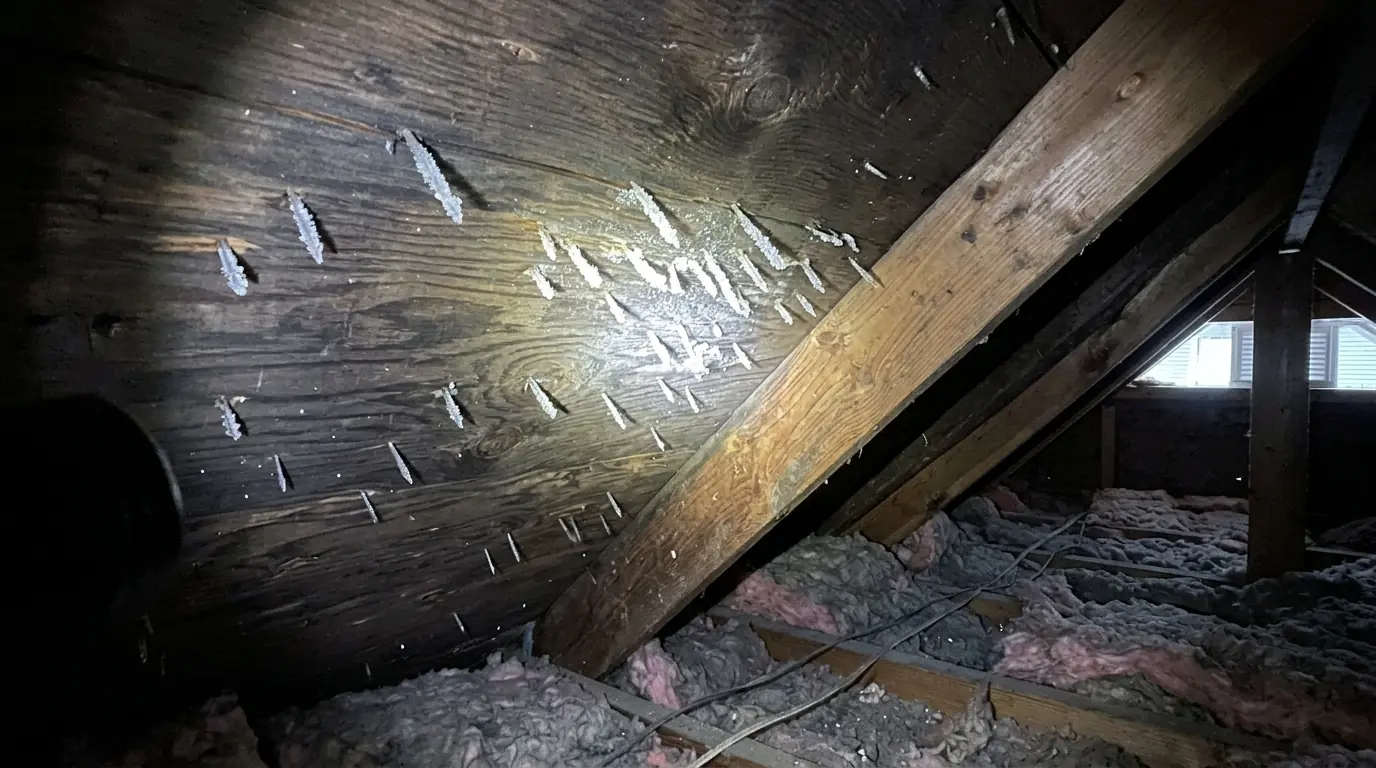
In a Tacoma attic, condensation shows up as frost or droplets on nail tips and wide damp patches on the sheathing after cold nights, while a roof leak leaves one trail that follows rain. Timing is the tell: water within hours of a storm points to a leak, and water during a dry cold snap points to moist house air.
Why moist air ends up in a Tacoma attic
Tacoma sees about 155 precipitation days a year, so outdoor air is damp for months at a time. Inside, cooking, showers, laundry and breathing add more moisture. Warm indoor air carries that water vapor up through gaps around light fixtures, the attic hatch, plumbing chases and bath fans.
When that air reaches the cold underside of the roof deck on a winter night, the vapor condenses into water, or into frost if the wood is below freezing. A well-vented attic carries most of it away. A poorly vented or poorly sealed one lets it build up until the sheathing darkens, the nails rust and water starts dripping onto the insulation.
Frost on nails and the drip that follows a thaw
Roofing nails poke through the deck into the attic, and their steel tips are the coldest thing up there. On a cold clear night they collect frost first, often as small white caps on every nail across a whole roof plane. When the sun or a warm front comes through, that frost melts all at once.
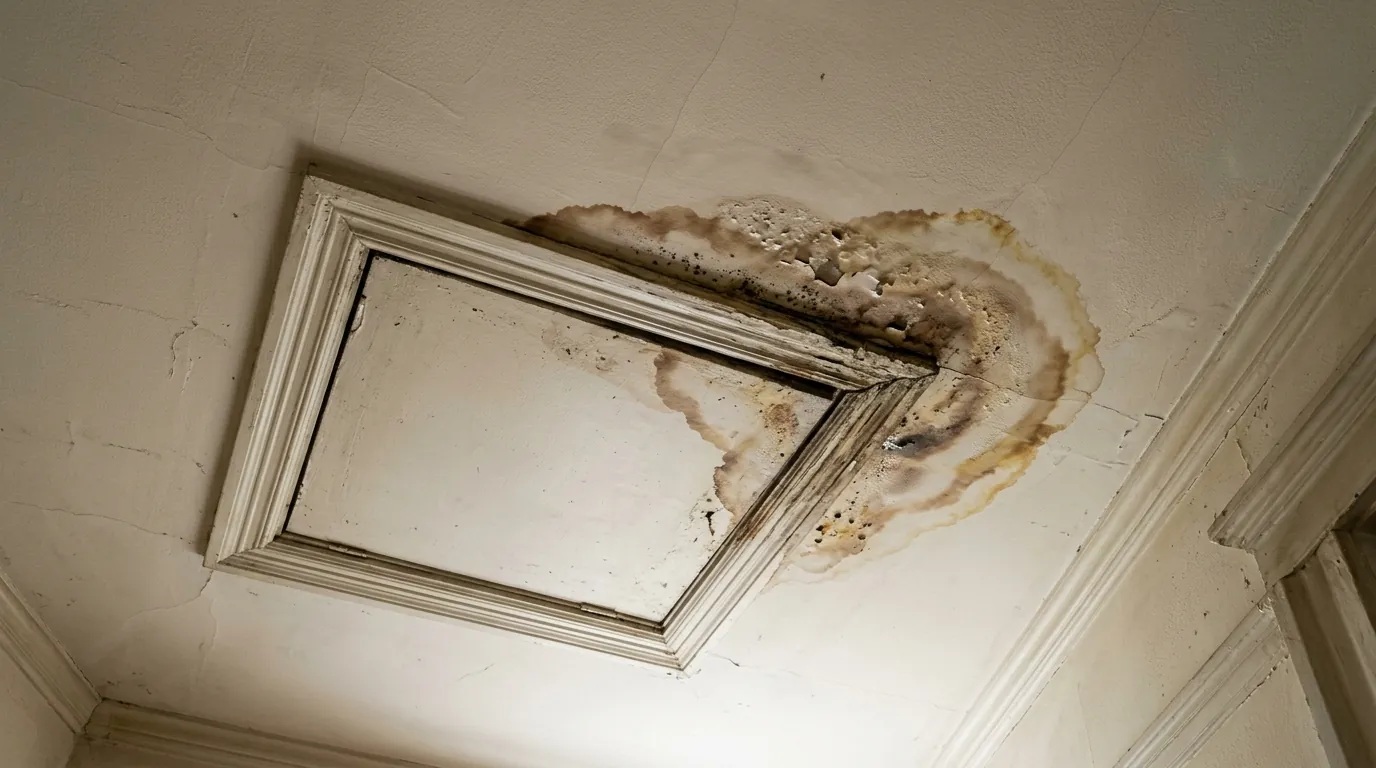
The result looks like a leak but behaves differently. You get small stains or drips spread across the ceiling in a dotted pattern, wet insulation in many spots, and water on a dry, sunny morning after a freeze. North-facing roof planes and the area above bathrooms and kitchens usually show it first.
Bath fans vented into the attic
A bath fan that blows into the attic instead of outside sends a shower's worth of moisture straight onto the roof deck every day. We find fans with no duct at all, ducts that end loose on the insulation, and ducts aimed at a soffit vent, where most of the air simply circulates back into the attic.
The fix is a sealed, insulated duct run to a roof or wall cap with a damper. Insulating the duct keeps condensation from forming inside it and running back into the fan. If your fan housing has rust or water stains, that is a strong sign of this problem. Our attic ventilation page covers bath fan venting.
Balancing intake and exhaust ventilation
Attic ventilation works as a flow: cool outside air comes in low at the soffits and leaves high at the ridge or roof vents. Most attics we find wet have plenty of exhaust and too little intake, often because insulation has been blown over the soffit vents or old vents were painted shut.
Mixing exhaust types can cause trouble too. A ridge vent beside a gable vent or a powered fan can pull air from the nearest opening instead of from the soffits, leaving the lower roof deck stale. Baffles at the eaves keep insulation off the intake path. Adding vents without sealing the ceiling below, though, can pull even more moist house air into the attic.
Rain leak or condensation: the tells side by side
Use this table the next time you find water in the attic. Note the weather for the past two days before you decide.
| Item | Roof leak | Condensation |
|---|---|---|
| When it shows up | During or soon after rain | Cold nights, thaws, dry spells |
| Pattern | One trail or spot | Spread across a whole roof plane |
| Where | Vents, chimneys, valleys, walls | Nail tips, north side, above baths |
| Wood | Stained along a path | Evenly darkened sheathing |
| Frost | None | White caps on nails in cold weather |
| Fix | Roof repair | Air sealing, venting, duct fixes |
Want a second pair of eyes?
We answer 24/7. Call (253) 449-1922 and describe what you are seeing.
Summer heat matters for the attic too
Ventilation is not only a winter problem. During the June 2021 heat dome, Sea-Tac reached 104 F on June 27 and 108 F on June 28. An attic with little airflow under a dark roof gets far hotter than that, which bakes shingles from below and pushes heat into the rooms under it. The same balanced intake and exhaust that dries an attic in winter vents that heat in summer.
Insulation, air sealing and a reroof
A reroof is the easiest time to fix attic problems, because the deck is open and the ridge is off. Under the Washington State Energy Code, a reroof that exposes an insulated roof cavity, as on a vaulted ceiling, must have that cavity insulated to full depth. We plan venting and attic insulation together so the new roof starts with a dry attic.
A short attic checklist
Go up with a flashlight on a cold morning and again after a rain, and check these.
- Frost or rust on nail tips across the roof plane
- Dark, even staining on the underside of the sheathing
- Bath and kitchen fan ducts sealed to an outside cap
- Soffit vents clear of insulation, with baffles in place
- Gaps around the hatch, lights and pipes sealed
- Stains that follow a path from a vent, chimney or valley
Questions readers ask
A little on the coldest mornings is common. Heavy frost every cold night means too much moist air is reaching the attic, and over winters it can rot sheathing and grow mold.
Yes. Melting frost drips onto insulation and soaks through to the drywall, often as several small stains rather than one big one.
Not on their own. Sealing air leaks from the house and fixing bath fan ducts usually matter more. Vents help once the moisture source is under control.
It can lower indoor moisture, especially in winter, but it does not fix fans vented into the attic or blocked soffits.
Look for a cap on the roof or wall near the bathroom, then turn the fan on and feel for airflow at the cap. In the attic, follow the duct.
Yes, if you are not sure which it is. We check both the roof and the attic, and our roof inspection covers ventilation.