Cedar shake roofing in Tacoma: repair it, replace it or convert it
A cedar roof can look good for years, then decline fast once moss and rot take hold. We repair sound shake roofs, replace worn ones in cedar, or convert them to composition.
- Answering 24/7
- Puyallup office
- Tacoma and Pierce County
Short answer
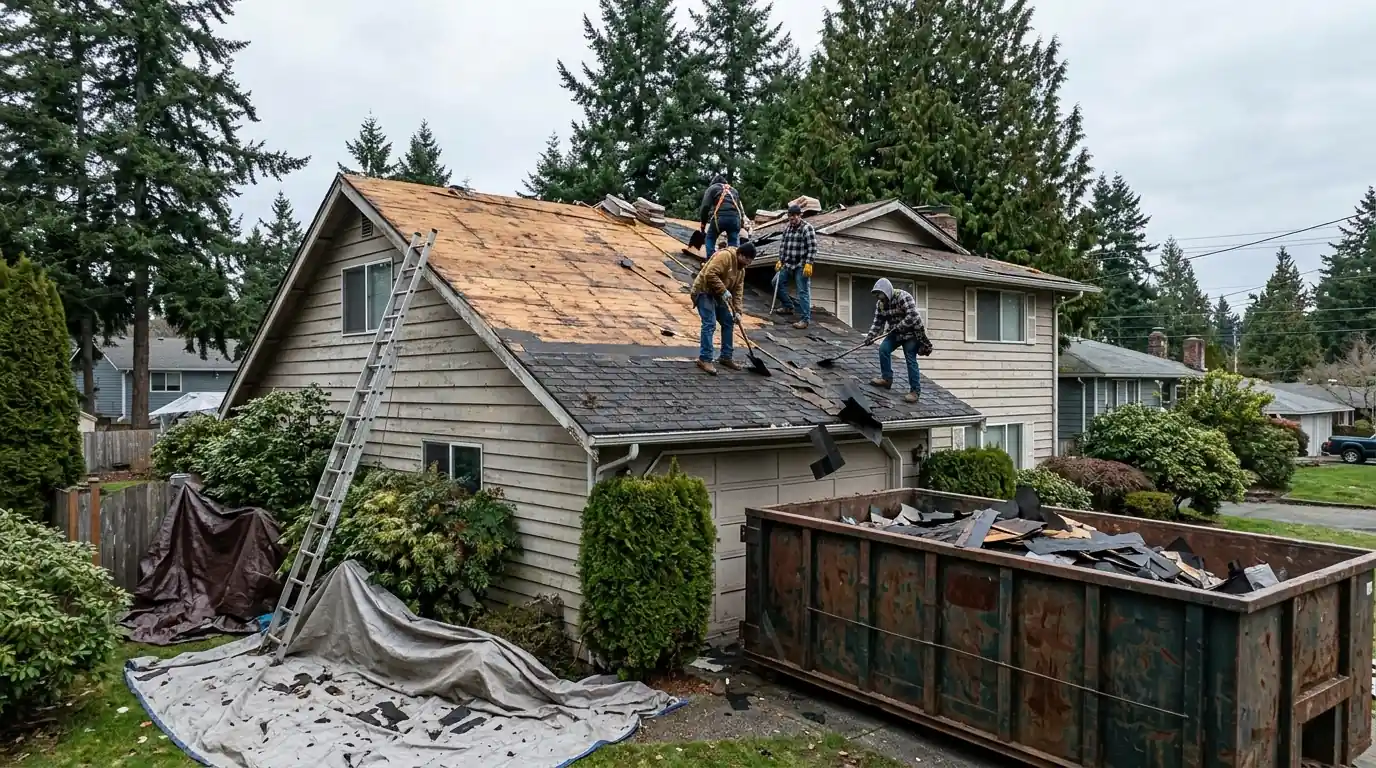
A cedar shake roof in Tacoma can be repaired while most shakes are still thick and solid, but once whole courses are split, cupped or soft, replacement or conversion is the better spend. Converting to composition means a full tear-off and solid sheathing over the old skip boards, since shingles cannot lie on spaced decking.
Keeping, replacing or retiring a cedar roof
Cedar wears from the top down. Sun and rain erode the exposed surface, the shakes thin and split, and moss holds water against the wood. A shake roof in decent shape can take repairs for years; one that has thinned past the point of holding a nail cannot.
The decision usually rests on three questions: how much of the roof is still sound, whether you want to keep the cedar look, and whether rules on the house limit the choice. Cedar replacement costs more and needs more care than composition, but on some houses nothing else looks right.
What moves the price of a cedar roof
Cedar work is priced by shake grade and by how much of the deck needs attention. The published range below is a national figure.
Published range, not a quote and not our price. Source: homeadvisor.com, 2026-06. Your number depends on the factors below and is set after we see the roof.
Repair, replace or convert
Each path has a very different scope.
Shake grade and thickness
Heavy hand-split costs more than medium taper-sawn.
Treatment
Pressure-treated cedar adds cost along with decay resistance.
Deck work
Converting needs solid sheathing over skip boards.
Roof shape and access
Dormers, valleys and steep pitches add labor.
Repair, replace in cedar or convert
Three realistic options for a worn shake roof.
| Item | Repair | Replace in cedar | Convert to composition |
|---|---|---|---|
| When it fits | Localized splits on a sound roof | You want to keep the cedar look | Most of the roof is worn |
| Deck work | None | Skip boards checked | Solid sheathing over skip boards |
| Upkeep after | Regular cleaning | Regular cleaning | Moss control only |
Shake repair
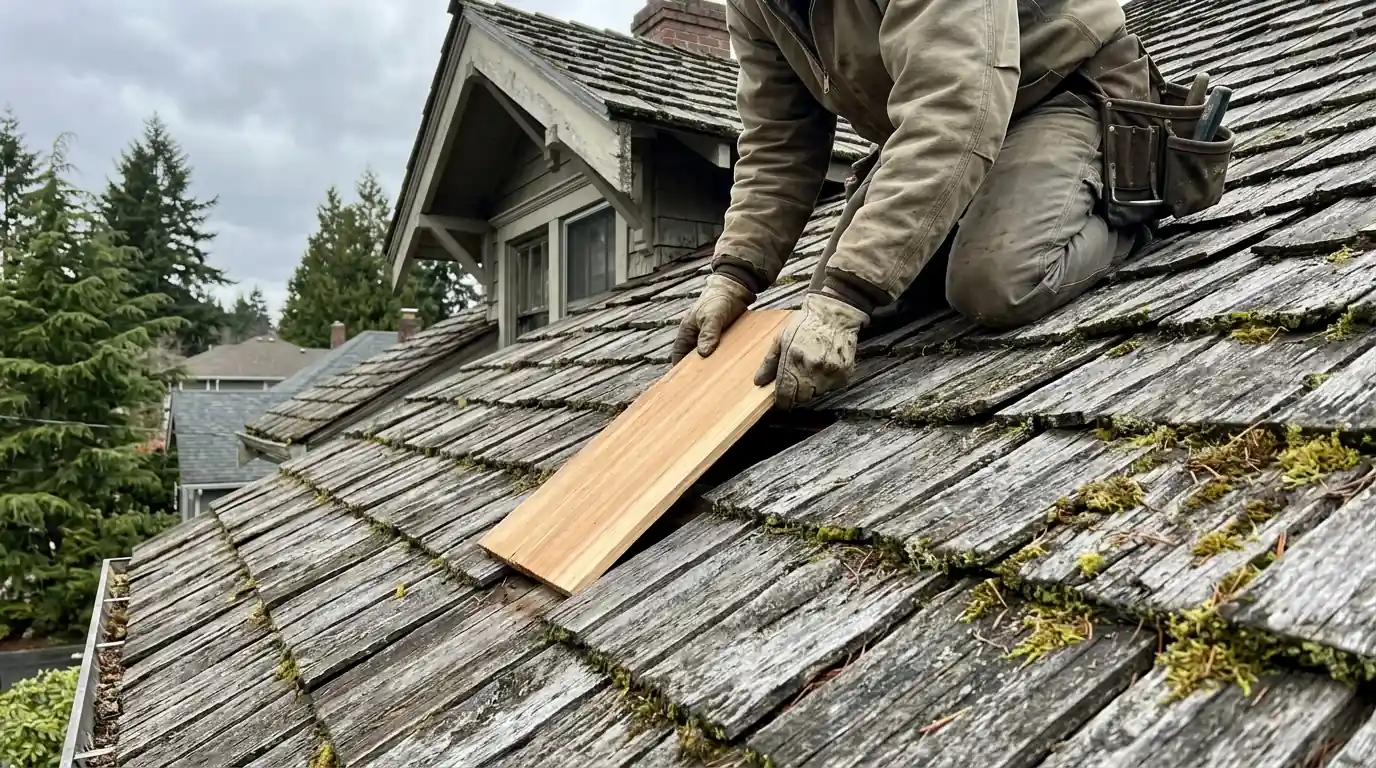
Individual split or missing shakes can be replaced without disturbing the course above. We slide out the broken pieces, cut the hidden nails with a shingle ripper, slip in a new shake of matching thickness and fasten it through the joint above. Fresh cedar starts out lighter than the weathered roof and grays over a season or two. Repair makes sense when the problem is localized: a branch strike, a few wind losses, or a worn patch around a vent. When splits run across whole slopes, patching becomes a cycle that never ends.
Shake replacement
Replacing a shake roof in cedar means tearing off to the deck, checking the skip sheathing or laying solid sheathing depending on the system, and installing new shakes with felt interlay between courses. Heavy hand-split, medium and taper-sawn shakes each give a different texture and price. Pressure-treated cedar resists decay longer on damp, shaded sites. A new cedar roof costs much more than composition and needs regular cleaning to reach its life, so we recommend it when the look matters to you or to the house, not by default.
Converting shakes to composition
For many owners the better answer is composition. Converting means stripping the shakes and their felt interlay, then covering the old spaced boards with plywood or OSB so the new shingles have a solid deck. Fascia, flashing and ridge details change as well, since a shingle roof sits lower than shakes. The result is lighter, cheaper to maintain and easier to repair, and thick architectural shingles give back some of the texture. Our asphalt shingle page covers the line choices.
Moss and rot on shakes
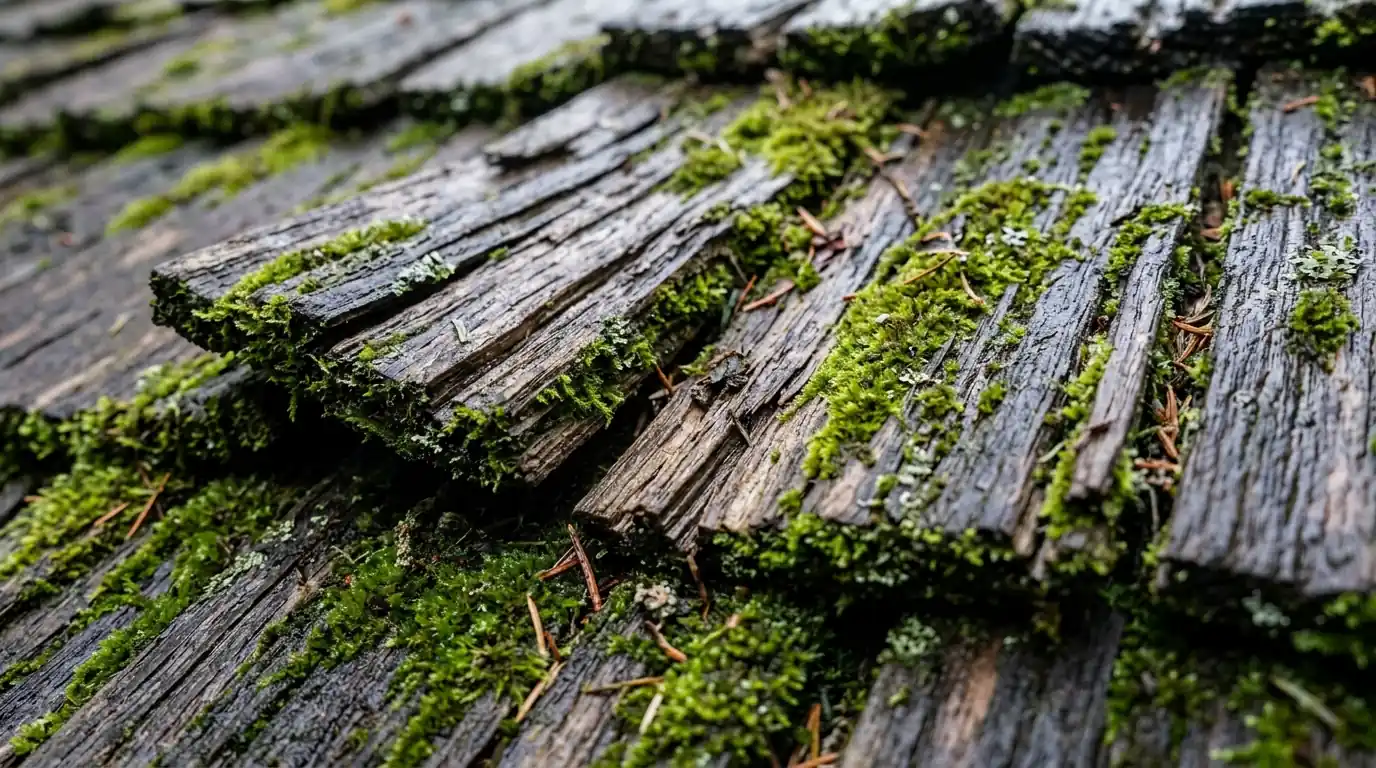
Moss does more harm on cedar than on shingles. It holds water in the gaps between shakes, swells the wood and pushes the butts up, which lets wind-driven rain in. Rot follows, usually on the shaded slope and along those gaps. We remove moss by hand and with soft brushing, never a pressure washer, which tears the wood fibers apart. A zinc strip near the ridge slows regrowth. Soft, punky shakes cannot be saved, and when they cover a whole slope, cleaning only buys a little time.
How a cedar roof job runs
We inspect the shakes
Thickness, splits, moss and soft spots on every slope.
We talk through the options
Repair, cedar replacement or conversion, with the tradeoffs.
We check the house's rules
Historic district guidelines can narrow the choice.
We clean or strip
Moss comes off for repairs; old shakes come off for replacements.
We prepare the deck
Skip boards checked, solid sheathing added where needed.
We install the new roof
Cedar with interlay, or underlayment and shingles.
We finish the ridge and edges
Ridge caps, flashing and a zinc strip where it helps.
North Slope and Wedge
Cedar on Tacoma's historic streets
Tacoma's North Slope Historic District has over 900 homes built from 1881 to 1955, and the Wedge district about 70 more from early Tacoma to just after WWI. If one of those homes still carries cedar, the district guidelines allow composition roofing in place of the original shingles, so converting a worn shake roof to a carefully chosen composition shingle is an accepted path. Metal is not acceptable on historic homes in either district. We help owners pick a color and profile that suits the age of the house.
Signs a shake roof is wearing out
Most of these show from the ground, especially with binoculars.
Shakes cupping or curling
Lifted butts let wind-driven rain in.
Splits lining up through courses
Aligned cracks give water a straight path down.
Thick moss mats
Moss holds water against the wood and lifts the shakes.
Soft or crumbling butts
Punky wood at the exposed edge means rot has started.
Gaps where shakes are missing
Wind or rot has taken pieces out of the field.
Cedar Shake Roofing questions from Tacoma homeowners
If most shakes are thick, firm and lying flat, repair works. Thin, split or soft shakes across whole slopes mean it is time to replace.
Pressure-treated shakes resist decay from the factory. Surface treatments on an older roof help a little but do not reverse wear.
Untreated cedar burns more readily than composition. Fire-retardant treated shakes are available where that matters to you.
It should not be. Pressure washing strips wood fibers and drives water under the shakes.
Yes, though thick architectural shingles keep some texture. Ask us about profiles that suit older houses.