Roof decking replacement in Tacoma, from one soft sheet to a full redeck
The deck is the plywood, OSB or boards the whole roof is nailed to. When it softens or delaminates, nails stop holding and even new shingles fail early.
- Answering 24/7
- Puyallup office
- Tacoma and Pierce County
Short answer
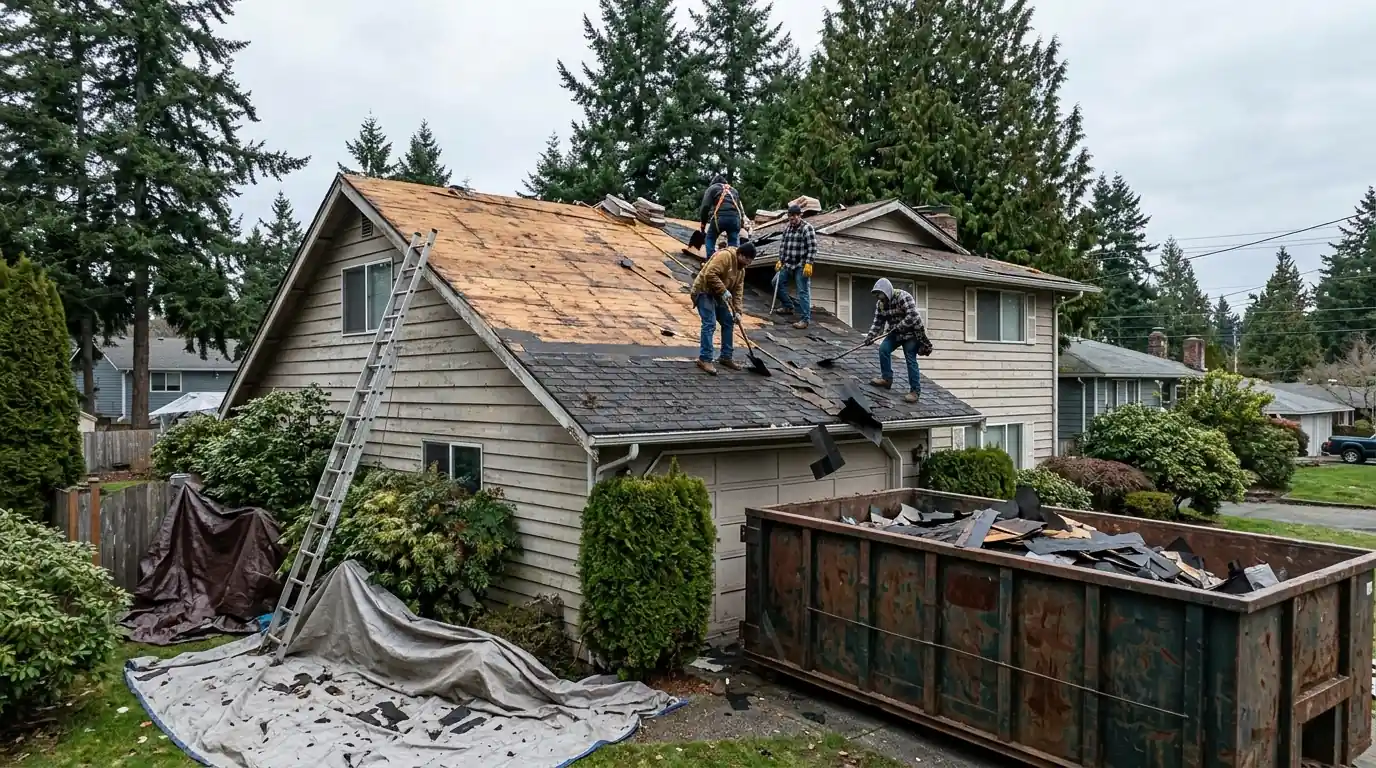
Roof decking on a Tacoma house is replaced during a tear-off, one sheet at a time wherever the wood is soft, delaminated or rotted, or across the whole roof when old skip boards sit under shakes. We use plywood or OSB in the thickness your rafter spacing calls for, and photograph every sheet we change.
Why the deck decides how long a roof lasts
Every shingle, nail and flashing is only as good as what it is fastened to. A deck that has soaked through a slow leak loses its grip on nails, a delaminated sheet blisters up under the shingles, and rotted edges let the roof droop at the eaves. New shingles on a bad deck will lift, ripple and leak early.
Most deck problems hide until the old roof comes off, which is why replacements carry a per-sheet rate for decking. Some show earlier: a spongy feel underfoot, sags between rafters, or dark stains in the attic. Once the deck is bare we sound all of it and replace only what fails.
What decides the cost of new decking
Decking is usually priced per sheet, because the count is unknown until the old roof is off.
How many sheets fail
One soft spot and a full redeck are very different jobs.
Plywood or OSB
Plywood costs more per sheet than OSB.
Skip sheathing
Covering a shake-era deck adds a full layer.
Rafter repairs
Rotted or cracked rafters get sistered first.
Inspection timing
Where an inspection is required, the deck waits open for it.
Plywood versus OSB
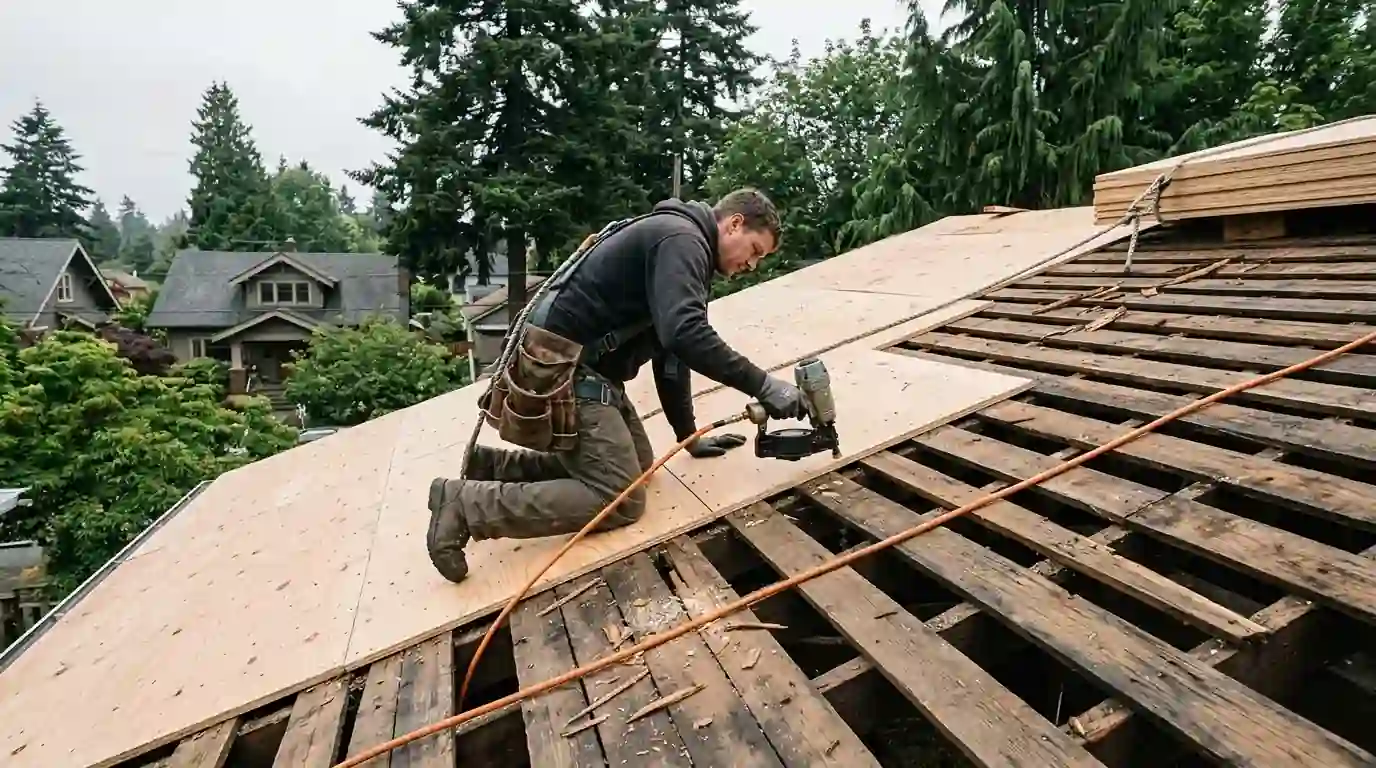
Both plywood and OSB are accepted roof decking, and both perform when installed with edge gaps and kept dry. Plywood is made of cross-laminated veneers; it tolerates a soaking and dries back better, and it holds nails a little better near the edges. OSB is made of compressed wood strands, costs less and is more uniform, but it swells at the edges if it stays wet and does not fully recover. On a damp, shaded roof or a low slope, we lean toward plywood. On a well-vented roof out in the open, OSB does the job.
Skip sheathing under old shakes
Cedar shake roofs were often laid on spaced boards, called skip sheathing, so air could move under the wood. Shingles and most modern roofing need a solid deck, so when the shakes come off the gaps have to be closed. Usually we lay new plywood or OSB over the boards and nail it into the rafters, which also stiffens the roof. Where the boards are rotted, or the added thickness would cause trouble at walls and edges, we remove them first. Either way, the eaves and rakes get trimmed and flashed to the new deck height.
Soft spots and delamination
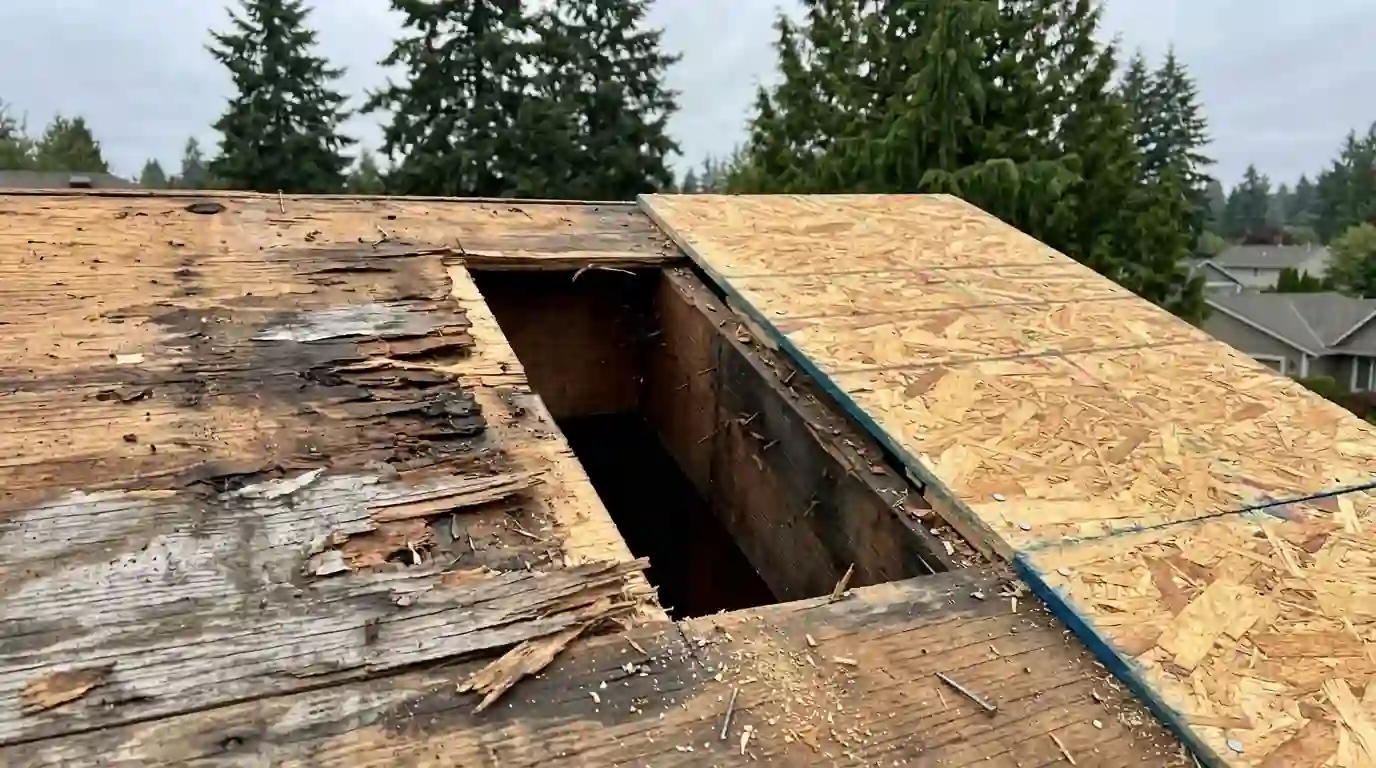
A soft spot underfoot is usually a sheet that has absorbed water from a leak, a failed vent or condensation from below. Delamination shows as plywood layers separating, often bulging under the shingles in a wavy line. We cut out the bad section back to the nearest rafters, replace it with sheathing of the same thickness, add clips at the seams where needed, and track down the water source. If the cause turns out to be attic moisture rather than a roof leak, new decking alone will fail the same way, and we will tell you so.
Eave boards and starter courses
The bottom edge of the deck takes water from every course above it and from gutters that overflow. Older houses often have solid board eaves, sometimes exposed from below as decorative soffits, and those boards rot from the outer edge inward. We cut back to sound wood and replace with matching boards where the underside shows, or with plywood where it is hidden. The starter course and drip edge then sit on a solid edge, which is what stops the first row of shingles from drooping or peeling up in wind.
How we replace roof decking
We set a per-sheet rate
You know the cost of each sheet before tear-off.
We strip the roof
Old layers come off so the deck is visible.
We sound every sheet
Walking and probing find soft or delaminated areas.
We show you the damage
Photos and a sheet count before anything is replaced.
We cut back to rafters
Bad sections come out to solid framing.
We fasten new sheathing
Correct thickness, edge gaps, nails on schedule.
We get it inspected if needed
The deck stays uncovered until it is signed off.
Pierce County and Puyallup
Sheathing rules around Tacoma
Pierce County needs no building permit to re-roof a home steeper than 2:12 with light coverings, but replacing sheathing is not exempt, which matters for owners in South Hill, Spanaway and Parkland. City of Puyallup re-roof permits call for an inspection before cover whenever sheathing is replaced, so new decking stays visible until the inspector has seen it. Across Tacoma, roughly one housing unit in four (26.9%) dates from 1939 or earlier, and houses that old often sit on board sheathing that needs close checking.
Wondering what is under your shingles?
Call any hour. We can look from the attic first and tell you what to expect before any tear-off.
Call (253) 449-1922Signs the deck under your roof is failing
Some deck problems show before tear-off. These are worth watching.
Sags between rafters
A wavy roofline seen from the street at a low angle.
A spongy feel underfoot
Anyone who walks the roof will notice it give.
Dark, stained boards in the attic
Long-term moisture weakens the wood.
Nails that missed the rafters
Shiners in the attic show fasteners holding nothing.
Rippling shingles
Swollen or delaminated sheets push the shingles up.
Roof Decking Replacement questions from Tacoma homeowners
Not until the roof is off. We set a per-sheet price beforehand and count the sheets with you after tear-off.
For a small area, yes, by removing and relaying the shingles above it. Larger areas are easier during a replacement.
No. OSB is an accepted decking material. It simply tolerates long wetting less well than plywood.
Thin or wet decking bows between supports. It can also mean undersized or cracked rafters, which we check from the attic.
Often it does, especially when the rot sits away from any leak. See attic ventilation for that side.