Chimney flashing and cricket repair in Tacoma, built into the masonry
A chimney is rigid masonry in a roof that moves, and the joint between them is where water gets in. We fix the reglets, the cricket and the crown.
- Answering 24/7
- Puyallup office
- Tacoma and Pierce County
Short answer
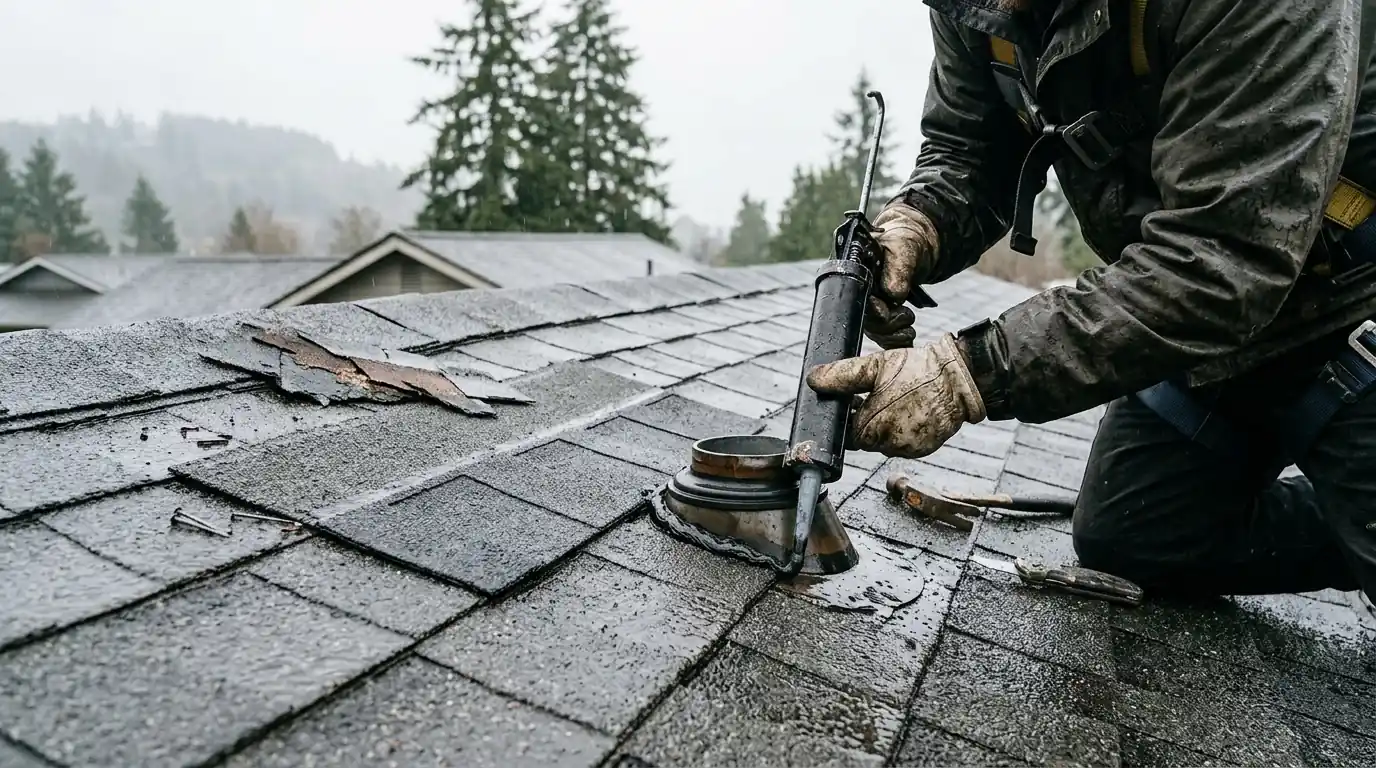
Chimney leaks in Tacoma come from one of three places: counter flashing pulled loose from the mortar, a missing or failed cricket on the uphill side, or water soaking down through a cracked crown or rusted chase cover. We grind new reglets into the joints, frame crickets behind wide chimneys, and seal or recast the crown.
Where masonry and roofing meet
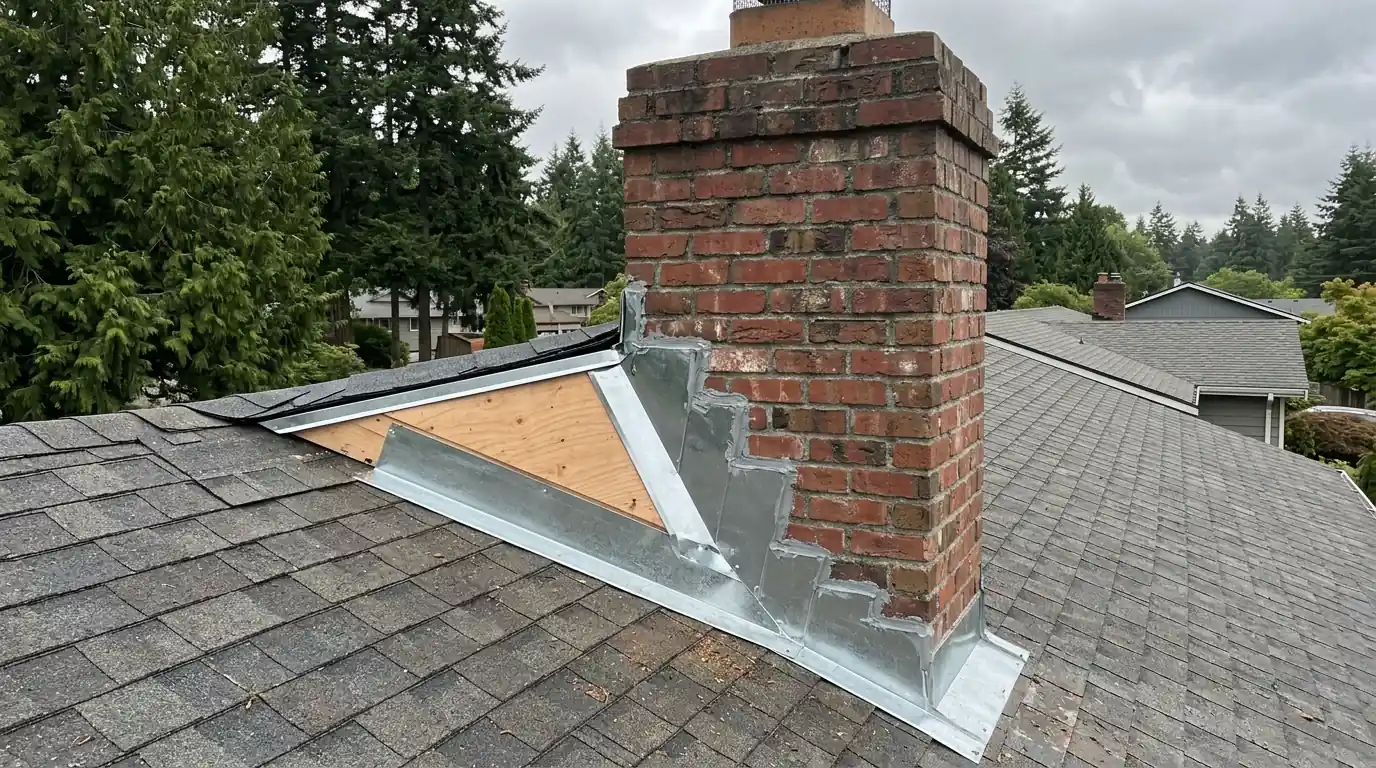
Brick and roof framing move differently. The roof swells and shrinks with moisture while the chimney barely moves. Flashing has to bridge that gap without being fixed rigidly to both, so a chimney gets two layers: base and step flashing tied to the roof, and counter flashing set into the masonry and lapped down over it.
Most chimney leaks come from a shortcut in that system: counter flashing caulked onto the brick face, no cricket, or a crown never built to shed water.
What drives the price of chimney flashing work
We price chimney work after seeing the masonry as well as the metal.
Published range, not a quote and not our price. Source: angi.com, 2026-09. Your number depends on the factors below and is set after we see the roof.
Chimney width
Wide chimneys need more metal and usually a cricket.
Mortar condition
Crumbling joints get repointed before reglets are cut.
Cricket framing
Building and flashing a cricket adds a stage.
Crown or cover work
Recasting a crown or replacing a chase cover adds materials.
Roof around the chimney
Brittle shingles may need replacing in a wider circle.
Three ways to fix chimney flashing
The quick patch and the lasting repair are different jobs.
| Item | Reseal surface flashing | Counter flashing in reglets | Remove the chimney |
|---|---|---|---|
| What it involves | Old sealant out, new bead along the top | Joints ground out, stepped metal set in | Chimney taken down, roof patched |
| How long it lasts | A season or two | As long as the roof around it | Leak source gone |
| Suits | A stopgap before a reroof | Working chimneys | Unused chimneys |
Counter flashing and reglets
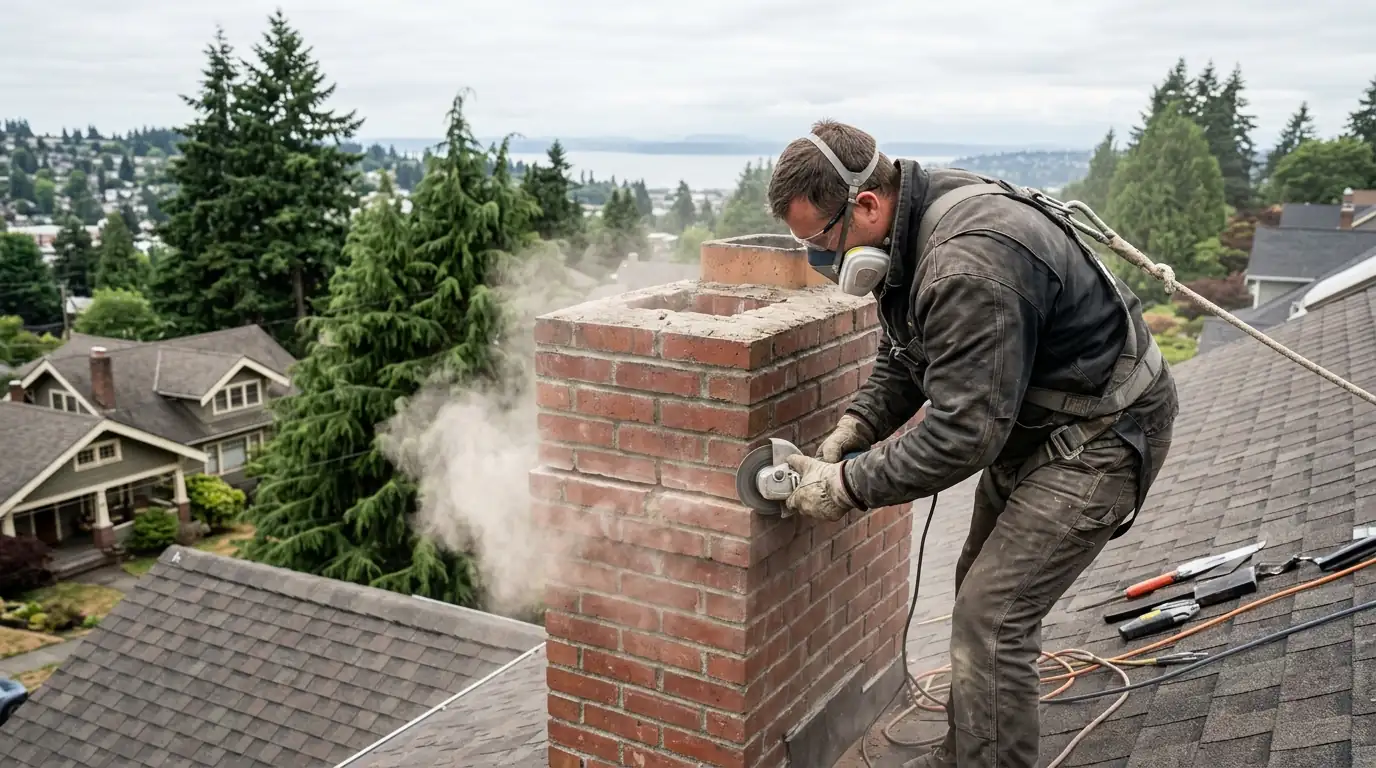
A reglet is a shallow slot ground into a mortar joint to hold the bent top edge of the counter flashing. Done right, water running down the brick passes over the flashing and onto the step pieces below. Many chimneys have surface-mounted counter flashing instead, held by a sealant bead that fails as the sun bakes it. We grind new reglets with a masonry blade, set stepped counter flashing into them, wedge each piece tight and seal the joint. Where the mortar is loose, the joint gets repointed before any cutting.
Chimney crickets
A cricket, sometimes called a saddle, is a small peaked structure framed on the uphill side of a chimney. Without one, water and fir needles pile against the back of the chimney through every storm until the back flashing rusts through. Wide chimneys need a cricket, and narrower ones on a long slope benefit from one. We frame it in lumber on the deck, sheathe it, wrap it in ice and water membrane and flash it into the counter flashing. On an existing roof that means opening the shingles behind the chimney.
Metal chase cover leaks
Framed chimneys, the kind clad in siding around a metal flue, are topped with a sheet metal chase cover instead of a masonry crown. Flat covers hold water, rust at the seams and around the flue collar, and leak straight down inside the chase. Stains on a wall or ceiling next to a fireplace insert are the usual sign. We replace rusted covers with a stainless or galvanized one that has a cross-broken top, a drip edge that overhangs the siding and a fresh storm collar. Sealant over a rusted cover rarely lasts a season.
Crown cracks
The crown is the cement cap on top of a brick chimney, sloped to carry water away from the flue tile. Many were poured with plain mortar that cracks through freeze and thaw, and water then soaks into the brick and runs down inside the chimney. Hairline cracks can be sealed with a flexible crown coating. Wide cracks, or a crown with no overhang, mean breaking it out and recasting it with a drip edge so water falls clear of the brick face.
How we rebuild a chimney's flashing
We inspect the chimney
Brick, mortar, crown and flashing all get a look.
We strip the old metal
Surface flashing and old sealant come off.
We repoint loose joints
Soft mortar is raked out and refilled where needed.
We frame the cricket
The uphill side gets one if the chimney needs it.
We lay base flashing
Step pieces and a front apron tie into the shingles.
We set counter flashing
Stepped pieces fit into fresh reglets and get sealed.
We finish the top
Crown cracks are sealed, or the crown is recast.
In Tacoma
Old brick chimneys in Tacoma's early neighborhoods
The Stadium-Seminary Historic District developed between 1888 and 1930, and roughly two in three North End homes, 65.2% by NeighborhoodScout's estimate, date from 1939 or earlier. Houses from those decades often have tall brick chimneys, soft old mortar and flashing patched over many times. We repoint loose joints before cutting reglets, because a groove ground into crumbling mortar will not hold metal. On the oldest chimneys we also check whether the crown was ever more than a skim of mortar.
Signs the chimney is letting water in
Check inside first, then from the yard.
Stains on the ceiling beside it
Water tracks down the masonry and spreads at the ceiling.
White deposits on attic brick
Salt bloom means water is moving through the brick.
Caulk along the top of the flashing
A sealant bead in place of a reglet will fail.
Debris piled behind the chimney
No cricket means water sits on the uphill side.
Cracks across the crown
Often visible from the yard with binoculars.
Chimney Flashing & Cricket Repair questions from Tacoma homeowners
Heavy rain overwhelms a missing cricket or soaks through a cracked crown. Light rain may never reach those weak points.
Sealant over surface-mounted flashing buys a season or so. Counter flashing set into reglets is the lasting fix.
Old brick and mortar can absorb water and pass it inside. We check the masonry before blaming the metal.
Taking it down below the roofline and decking over the hole ends those leaks for good, ideally during a roof replacement.
We use prefinished metal close to the shingle or brick color, or copper where it suits the house.