Roof flashing repair in Tacoma for walls, dormers and roof edges
Flashing is the sheet metal that turns water back onto the roof where a slope meets a wall or an edge. When it fails, the wall leaks.
- Answering 24/7
- Puyallup office
- Tacoma and Pierce County
Short answer
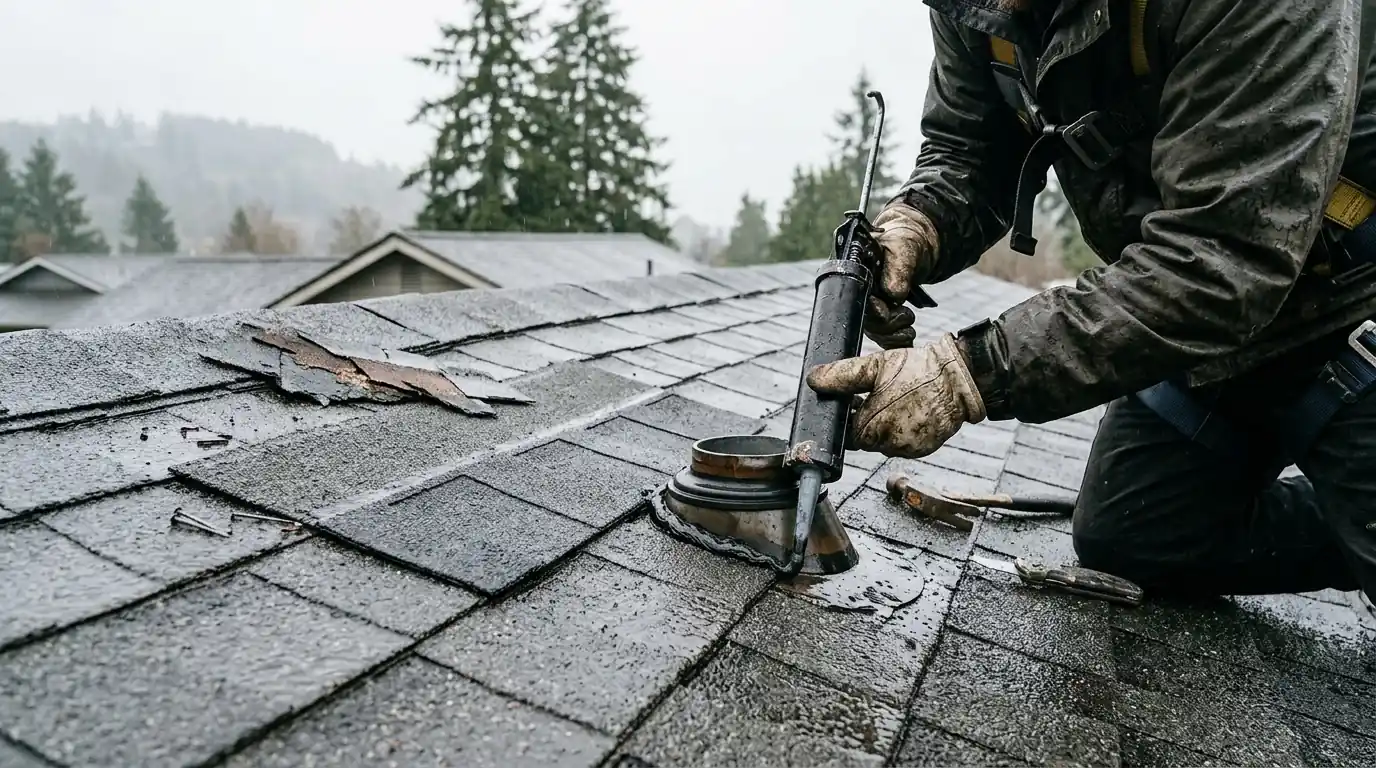
Most flashing leaks on Tacoma houses happen where a roof slope runs into a wall, and the fix means pulling the siding back far enough to replace the metal underneath. We repair step, kick-out, counter and drip edge flashing, and we replace pieces rather than smearing sealant over them, since a bead of caulk lasts only a few wet seasons.
Why flashing fails before the shingles do
Shingles shed water across a slope, but wherever the slope stops, against a wall, beside a dormer or at an edge, something has to turn that water back onto the roof. That something is flashing: bent galvanized steel, aluminum or copper, layered so each piece laps over the one below.
It fails in predictable ways. Steel rusts where wet debris sits against it. Pieces get bent or left out when siding is replaced. Plenty of older repairs rely on roof cement that cracked years ago. We take off enough siding or trim to see each piece, replace what is rusted or missing, and rebuild the laps in order.
What sets the cost of a flashing repair
Flashing is priced by length and by what has to come off the wall. The range below covers small repairs.
Published range, not a quote and not our price. Source: homeadvisor.com, 2026-06. Your number depends on the factors below and is set after we see the roof.
Wall cladding
Lap siding comes off easily; stucco takes longer.
Length of the junction
A short dormer cheek costs less than a two-story wall.
Rot behind the flashing
Wet sheathing or framing adds carpentry.
Metal and finish
Prefinished steel matched to trim costs more than bare galvanized.
Roof access
Steep slopes and high walls need more staging.
Step flashing
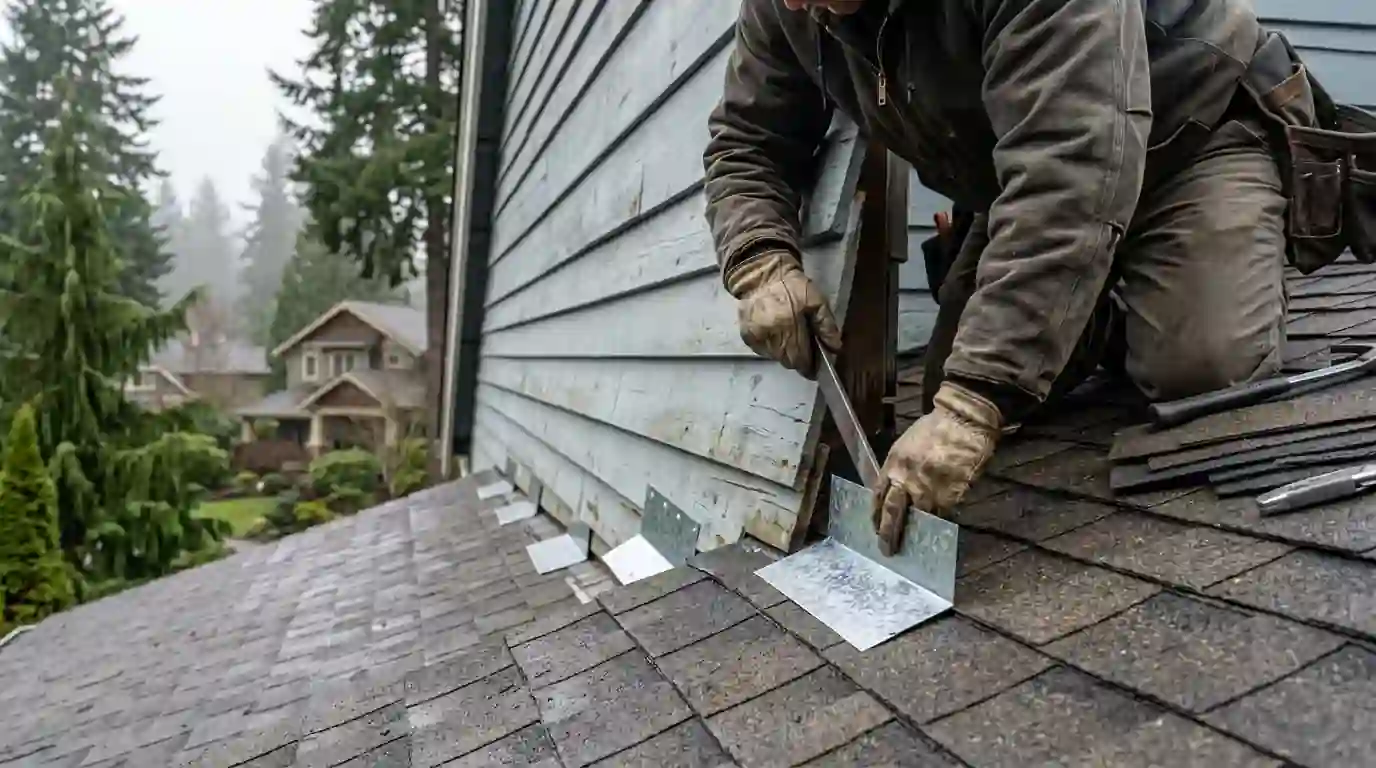
Where a roof runs up a sidewall, each shingle course gets its own L-shaped piece of step flashing, tucked under the siding and lapped over the shingle below. Water running down the wall steps from piece to piece and back onto the roof. A single continuous strip along the wall, or steps cut too short, will leak. You usually see it as stains along an outside wall or rot at the bottom of the siding. We remove the siding course along the wall, replace the steps one per course, and lap new house wrap over them.
Kick-out flashing
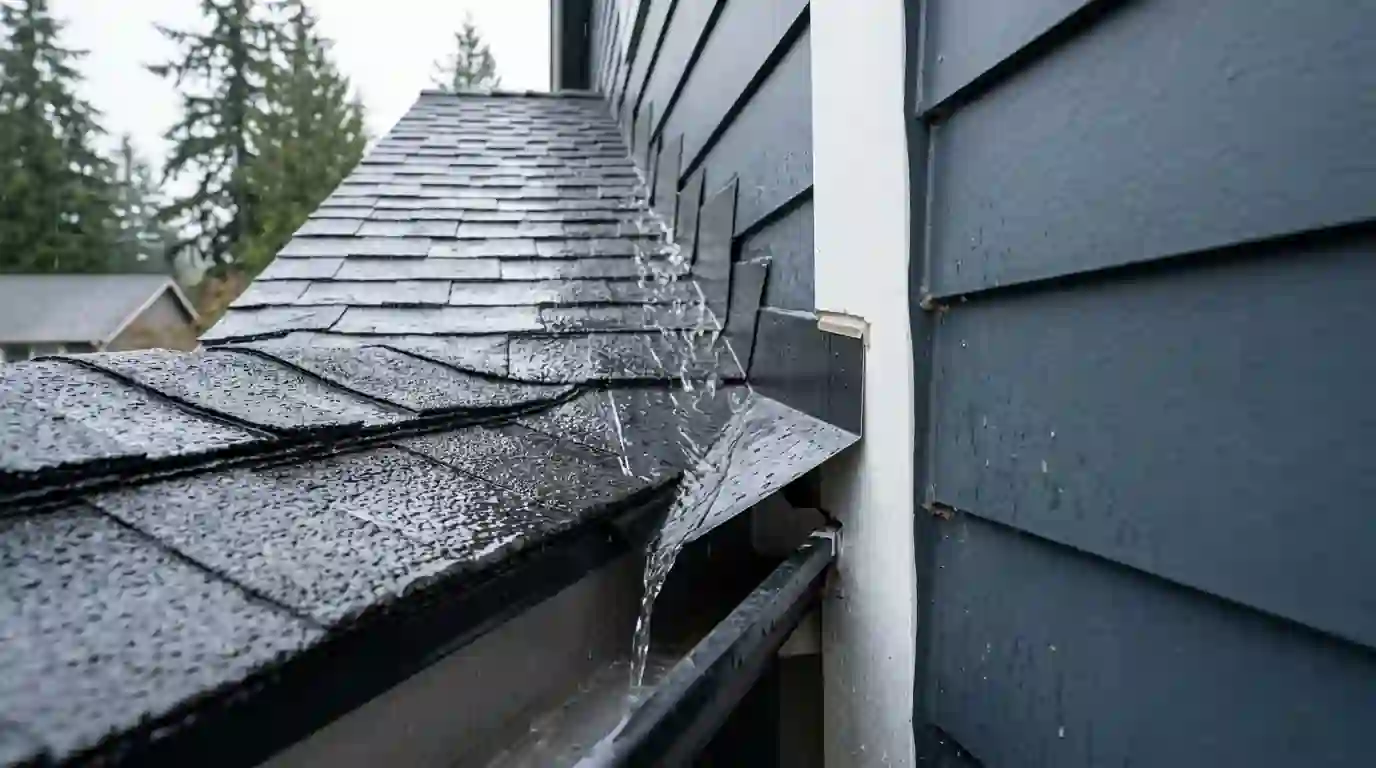
A kick-out is a small angled piece at the bottom of a roof-to-wall junction, where the roof edge ends but the wall keeps going. Its job is to throw water into the gutter instead of letting it sheet down the wall face. Plenty of houses were built before kick-outs were common, and the result is rotted sheathing and siding in a triangle below that corner. We add the kick-out, then open the wall underneath to see how far the rot has spread. Fixing the flashing without fixing the rot only hides the damage.
Counter flashing
Step flashing needs a cover wherever the wall is stucco or another surface that cannot overlap it the way lap siding does. That cover is counter flashing, a strip fixed to the wall and bent down over the steps. When it is missing, a sealant bead usually fills the gap, and sealant does not last. We install new counter flashing with a hemmed lower edge, fastened to the wall and sealed along the top. On brick chimneys it gets cut into the mortar joints instead, which our chimney page covers.
Drip edge
Drip edge is the L-shaped metal along the eaves and rakes. It carries water past the fascia into the gutter and keeps wind-driven rain from wicking back under the first course. Older roofs were often built without it, and the fascia and deck edges on those houses rot first. We slide new drip edge under the underlayment at the eaves and over it on the rakes, so water laps the right way at both. Adding it to an existing roof means lifting the first course or two, so on a tired roof it fits better into a replacement.
How we rebuild a flashing junction
You describe the leak
Where the stain is and which wall it sits on.
We look from both sides
Attic and wall stains show which junction is failing.
We open the wall
Siding or trim comes off along the junction.
We check the sheathing
Soft or stained wood gets cut out and replaced.
We set new flashing
Each piece laps the one below in the right order.
We restore the wall
House wrap, siding and trim go back with proper laps.
We seal and paint
Exposed metal and cut siding ends get finished.
Tacoma and Puyallup
Older Tacoma walls and Puyallup edge rules
About 26.9% of Tacoma housing units were built in 1939 or earlier, and another 7.9% in the 1940s. Houses that old have usually been reroofed more than once, and their step flashing was often reused or swapped for tar rather than rebuilt. City of Puyallup re-roof permits require drip edge on all roof edges, which matters when a flashing repair grows into a reroof there. On any older house we check the eaves for missing drip edge while we work on the walls above.
Stain along a wall after every storm?
Call any hour. Tell us which wall, and we will check the flashing above it.
Call (253) 449-1922Signs a flashing junction is failing
Most of these show on the wall or ceiling below the junction.
Stains along an outside wall
Ceiling or wall marks next to a roof-to-wall line.
Soft siding below a roof corner
Rot in a triangle shape under a roof edge.
Tar smeared along a wall
Old patches mean someone chased this leak before.
Rust streaks on siding
Rusting steps bleed down the wall face.
Peeling paint at the eaves
Missing drip edge lets water wick into the fascia.
Roof Flashing Repair questions from Tacoma homeowners
Caulk bridges a small gap for a while, but it cracks as the metal moves with temperature. Replacing the piece lasts far longer.
Usually a course or two along the junction. We save boards where we can and match any that split.
A missing kick-out lets roof water run down the wall face. The rot usually sits in a triangle below that corner.
On a sound roof with rotting fascia, yes. On a roof near the end of its life, add it during the replacement.
Galvanized or prefinished steel, colored to the trim where it shows. Copper never touches aluminum or galvanized metal, since they corrode each other.