Roof Replacement
Many 1970s to 1990s roofs here are on their second layer and due for a tear-off.
DetailsMost West End houses are newer than the rest of Tacoma, but newer here still means thirty to fifty years old. Roofs from that era are coming due.
Short answer
Yes, we work across Tacoma's West End, where NeighborhoodScout describes most homes as built from 1970 to 1999. Many of those houses are on a second roof now, some laid over the first one. We see a steady mix of reroofs, moss treatment on shaded north slopes, and gutter work on both owner-occupied homes and rentals.
NeighborhoodScout describes West End housing as mostly built from 1970 to 1999, with some homes from 1940 to 1969 mixed in. Most are single-story ramblers and split-levels with moderate pitches, which makes them simpler to reroof than the steep older houses closer to downtown.
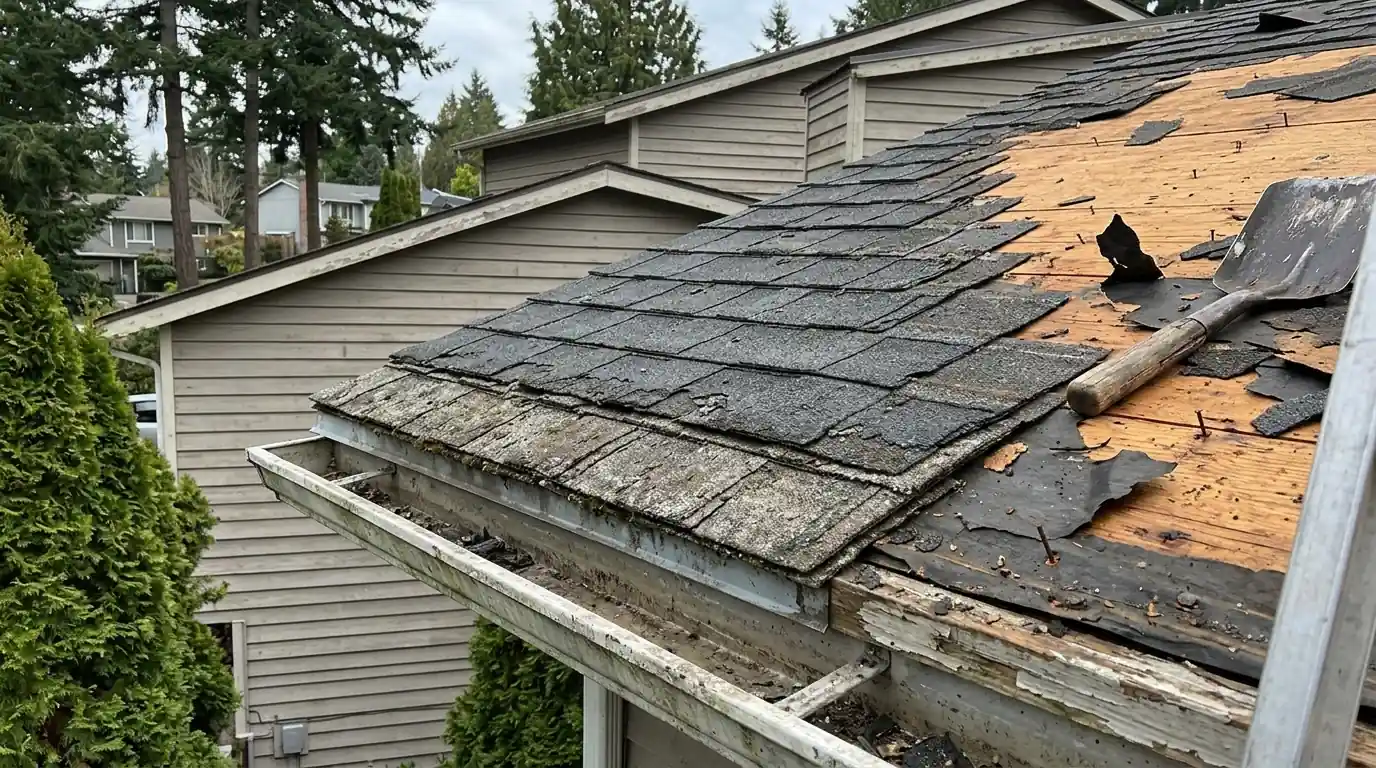
The catch is history. Through the 1980s and 1990s, laying new shingles over old ones was common, and plenty of West End houses still carry two layers. A Tacoma permit guide reports that a new layer over existing roofing needs a permit and pre-roof inspection. We prefer a full tear-off, which in Tacoma is often permit-exempt for a single-family house when the framing stays the same, and which lets us see the deck. Our roof replacement page covers the steps.
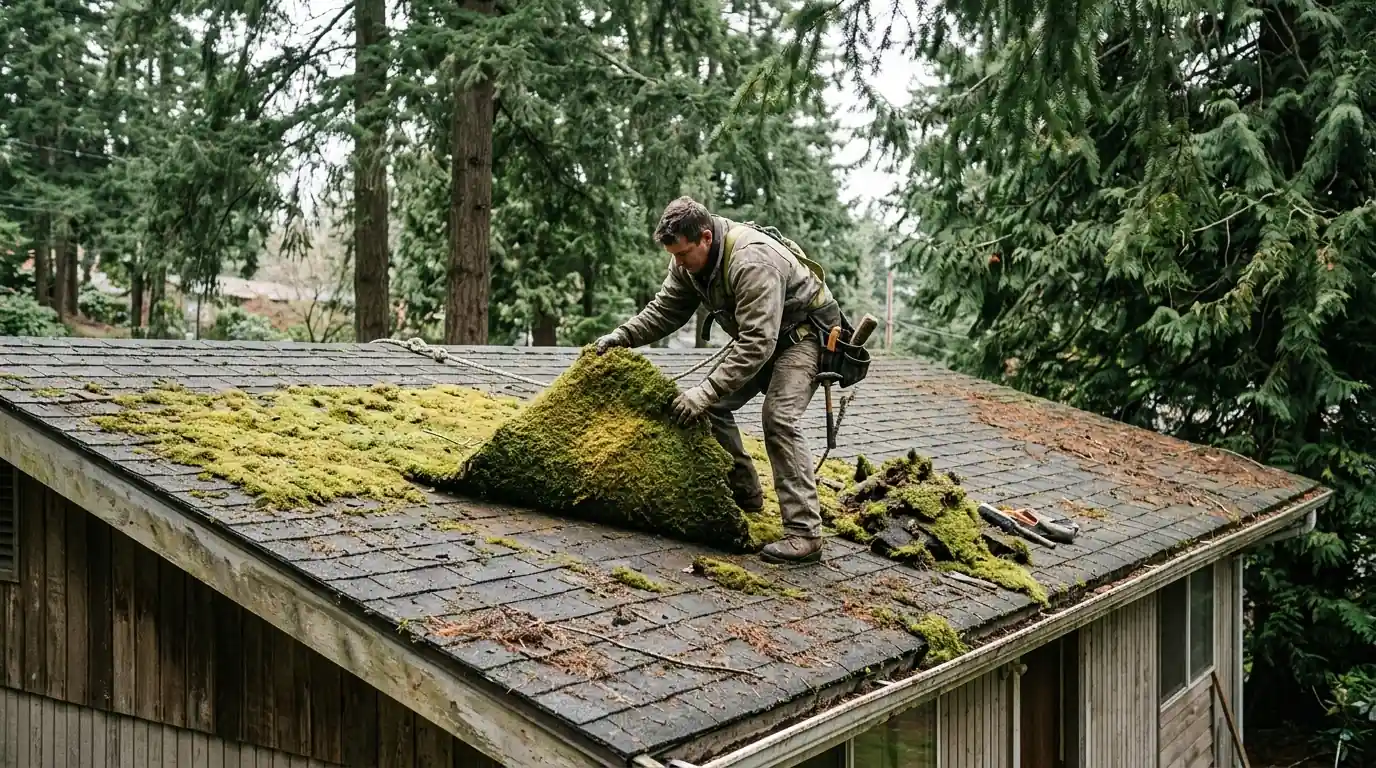
Sea-Tac averages 39.34 inches of rain a year over about 156 days, and moss loves a roof that stays damp. Tree cover across Tacoma ranges from 3% to 64% between census blocks, and residential property holds 44% of the city's canopy. Where a West End lot backs onto tall firs, the north slope of the roof often grows a thick mat that lifts shingle edges and holds water against the granules.
We remove moss by hand from the top down, then treat and install zinc strips where they make sense. We skip pressure washing because it drives water under the shingles. Our moss guide explains when moss means treatment and when it means a new roof.
The West End has a mix of owners and renters. For landlords, the most common call is a roof or gutter problem a tenant noticed, followed by a question about whether to repair or replace. We give a straight answer on the remaining life of the roof so the decision can be budgeted.
For owners, gutter work is often the next job after a reroof. Older sectional gutters on houses from this era leak at the seams, and many were sized for less roof area than the house has after additions.
Many 1970s to 1990s roofs here are on their second layer and due for a tear-off.
DetailsShaded north slopes under firs grow moss that lifts shingle edges.
DetailsOlder sectional gutters leak at seams and are often undersized for the roof.
DetailsRental owners use yearly upkeep to stretch a roof to a planned replacement.
DetailsRamblers from this era often lack enough intake to keep the attic dry.
DetailsLots backing onto fir stands fill gutters with needles every fall.
DetailsLook at the edge of the roof at the gutter line. Two stacked shingle edges, or a thick edge, usually means an overlay. We confirm on the visit.
Yes. We remove it by hand and treat what remains. Pressure washing forces water under shingles and strips granules.
Yes, if you give us permission and contact details. We arrange access with the tenant and report findings back to you.
An overlay in Tacoma needs a permit and inspection. We usually recommend a tear-off so the deck can be checked and repaired.
Zinc can streak slightly below the strip, and it corrodes copper gutters. Our moss removal page covers where we use it.
Or see the full South Sound coverage overview.
Call any hour. Tell us roughly when it was last replaced and whether you see moss or curling.
Calls are answered around the clock. Tell us what you are seeing and where the house is, and we will set up a visit.
Our office sits in Puyallup, and our crews work across Tacoma and Pierce County. The map loads only when you ask for it.