Moss on a Tacoma roof: remove it, treat it or replace the roof
Moss on a Tacoma roof is close to certain in shade. The question is whether it has already done damage, and which of three answers fits your roof.
By Kathleen Peabody, Roofing Guides Editor · Updated October 2026
- Answering 24/7
- Puyallup office
- Tacoma and Pierce County
Short answer
Moss on a Tacoma roof should come off by hand brushing, not pressure washing, followed by a treatment that slows regrowth. Tacoma averages about 40.81 inches of precipitation a year, so shaded roofs regrow moss quickly. If shingles under thick moss are lifted, curled or bare of granules, replacement may make more sense than cleaning.
Why moss grows so well on Tacoma roofs
Moss needs water and shade, and Tacoma supplies both. The city's own climate table shows roughly 40.81 inches of precipitation spread across about 155 days a year, so roofs stay damp for months at a time. A shaded north slope may barely dry out between November and April.
Trees add the shade. The City of Tacoma measured tree canopy at about 20% of its land area in 2017, but coverage ranged from 3% to 64% across census blocks. A house in a leafy block can carry a roof that never sees full sun, while one a few streets away stays clean for years.
Oregon State University Extension notes that roof moss follows shade, which is why it collects on north faces, under overhanging limbs and in the strip below a taller roof plane.
What moss actually does to shingles
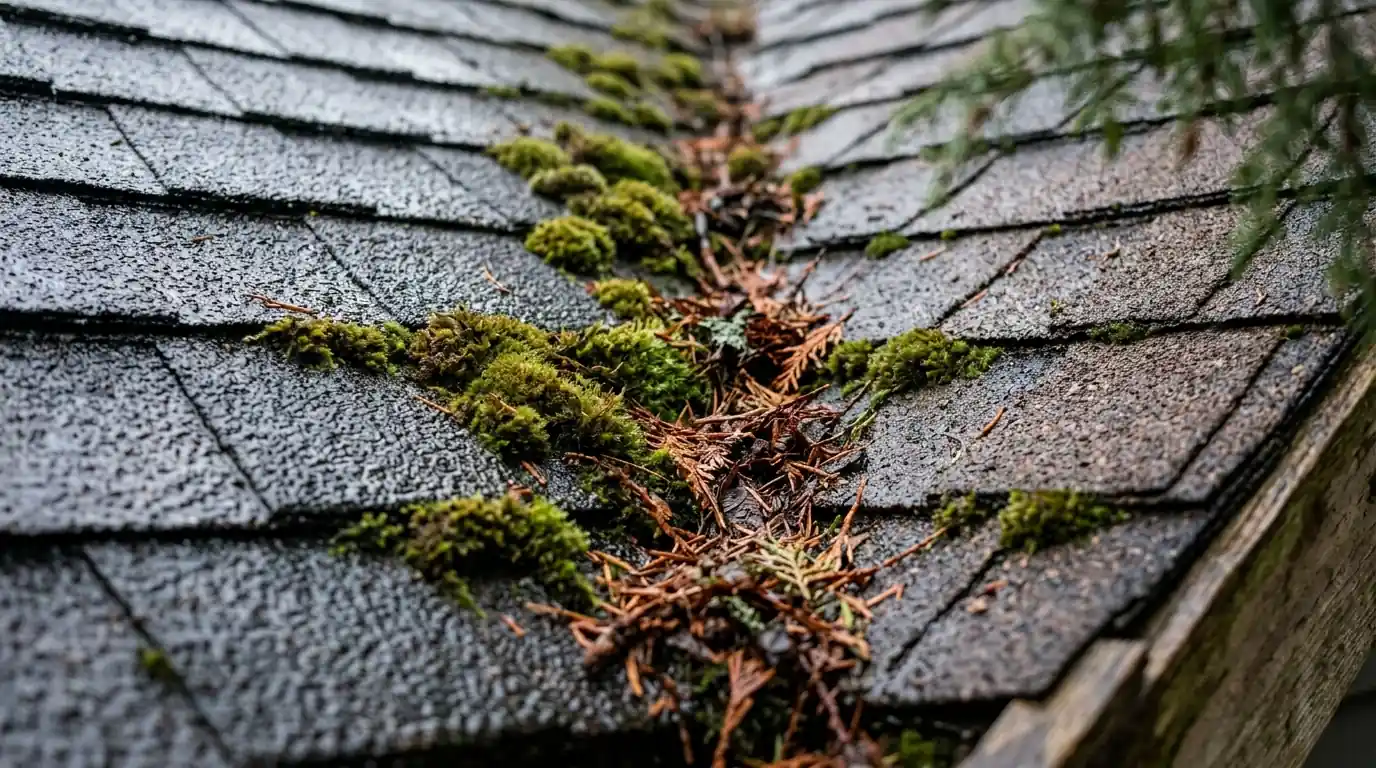
Moss is not just a cosmetic problem. OSU Extension says it holds moisture against the roof and can lift shingles. A thick mat acts like a sponge, keeping the shingle surface wet long after rain stops, and its roots work into the gaps between tabs.
Once a shingle edge lifts, wind can get under it and rain can run backward under the course above. Fir needles and debris caught in the moss make the mat thicker and dam water in valleys. Over a few seasons the granules loosen and wash into the gutters, and the bare asphalt underneath ages faster.
Why we do not pressure wash a mossy roof
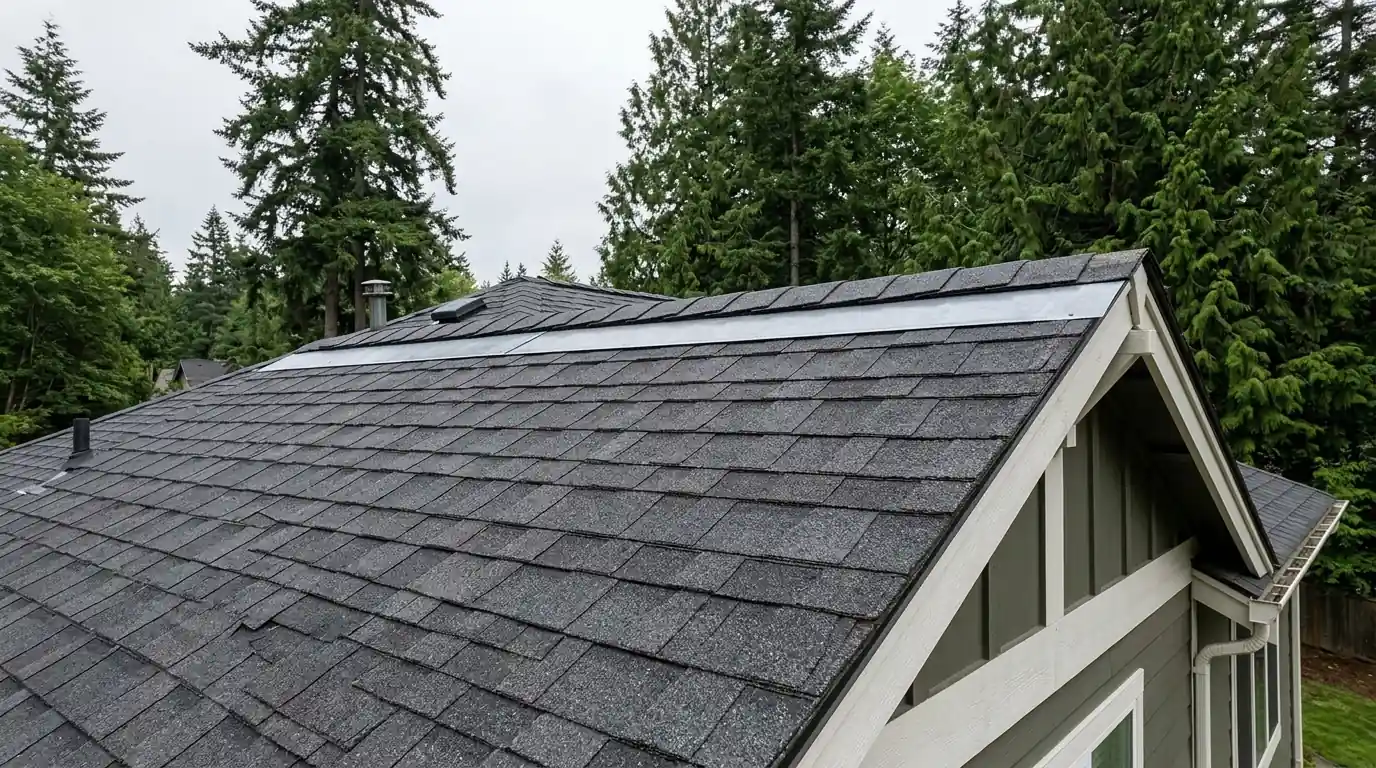
A pressure washer clears moss in minutes, which is why it is tempting. A Seattle Public Utilities moss fact sheet warns that pressure washing can force water under shingles or damage them. The spray strips granules, breaks the seal strips that hold tabs down, and drives water up under the courses where it soaks the deck.
We see the results later as leaks and bald patches that were never there while the moss was. On cedar shakes the damage is worse, because high pressure tears the soft wood fibers apart.
Remove: brushing it off by hand
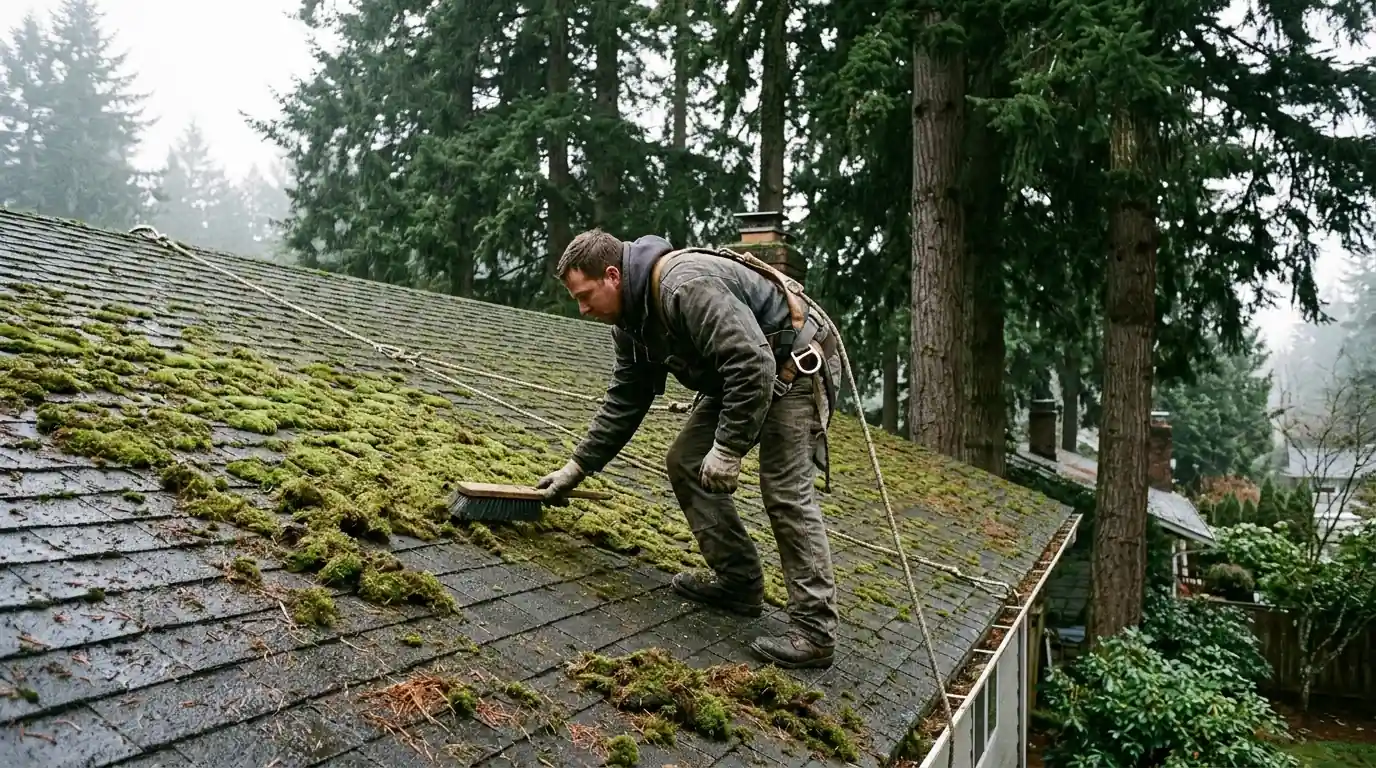
The gentler method works better. We brush moss off from the top of the roof downward with a stiff brush or a plastic scraper, so we move with the shingle laps instead of against them. Thick clumps get loosened by hand. The roof should be dry enough to walk safely, and steep roofs need harness anchors.
Timing matters. The SPU fact sheet notes moss revives with the rains and is most visible from early winter to late spring. That is when you notice it, but removal on a dry day in late spring or early fall, followed by treatment, gives the roof the longest clean stretch.
After brushing we clear the gutters and downspouts, because the debris has to go somewhere and it usually goes there.
Want a second pair of eyes?
We answer 24/7. Call (253) 449-1922 and describe what you are seeing.
Treat: zinc strips, sprays and copper gutters
Treatment slows regrowth; it does not replace removal. Zinc or copper strips installed near the ridge release metal ions with each rain, which discourages moss on the slope below. They work best on the upper part of the roof and lose effect further down, and they do little where moss is already thick.
Check your gutters before choosing a treatment. OSU Extension warns that zinc treatments corrode copper gutters, so a house with copper gutters or downspouts needs a different product. Zinc runoff also ends up in the soil below the downspouts, which is worth thinking about near vegetable beds.
The cost box shows a published national range for cleaning and prevention treatment. Roof size, pitch and how thick the moss is set where your roof falls in it.
Published range, not a quote and not our price. Source: thisoldhouse.com, 2026-03. Your number depends on the factors below and is set after we see the roof.
When moss means the roof needs replacing
Sometimes the moss has done its damage already. After cleaning, look at the shingles from a ladder or ask us to. These signs point toward replacement rather than another round of cleaning:
- Shingle tabs curled, cupped or lifted across large areas
- Bare asphalt where granules have washed away
- Soft or spongy decking underfoot in shaded sections
- Leaks or attic staining under the mossiest slope
- A roof already near the end of its expected life
Trees and shade: the long-term fix
OSU Extension calls trimming trees the long-term fix, because removing shade removes the conditions moss needs. Thinning limbs that hang over the roof lets sun and wind dry the surface after rain. An arborist can do that without harming the tree.
Trees are not going anywhere in Tacoma. The city's urban forest plan targets 30% canopy by 2030, and residential property holds 44% of the current canopy. So for most owners the realistic plan is a mix: thin the limbs over the roof, clean on a schedule, and treat between cleanings. Our roof maintenance visits fold that into one routine.
Questions readers ask
A light film is not urgent, but it thickens every wet season. Brushing it off early is easier and gentler on shingles than removing a thick mat later.
We still advise against it. Even low pressure aimed up the roof drives water under the laps and strips granules, as Seattle Public Utilities guidance warns.
No. They slow regrowth, mostly on the upper part of each slope. Thick moss has to be removed first, and lower sections may still need periodic cleaning.
Avoid zinc products. OSU Extension warns zinc treatments corrode copper gutters, so we choose a different treatment and keep runoff away from the copper.
A dry day in late spring or early fall works well. The roof is safe to walk, and treatment gets time to act before the heavy rains return.
Not always. If shingles are still flat and keep their granules after cleaning, treatment is enough. Curling, bare spots and soft decking point toward replacement.