Roof Replacement
Tear-offs here are planned around the city's inspection before cover.
DetailsOur office is in Puyallup, so this is the city we know most closely. Roofs here range from a small share of pre-1940 houses to the 1980s and 1990s homes that make up its biggest building decades.
Short answer
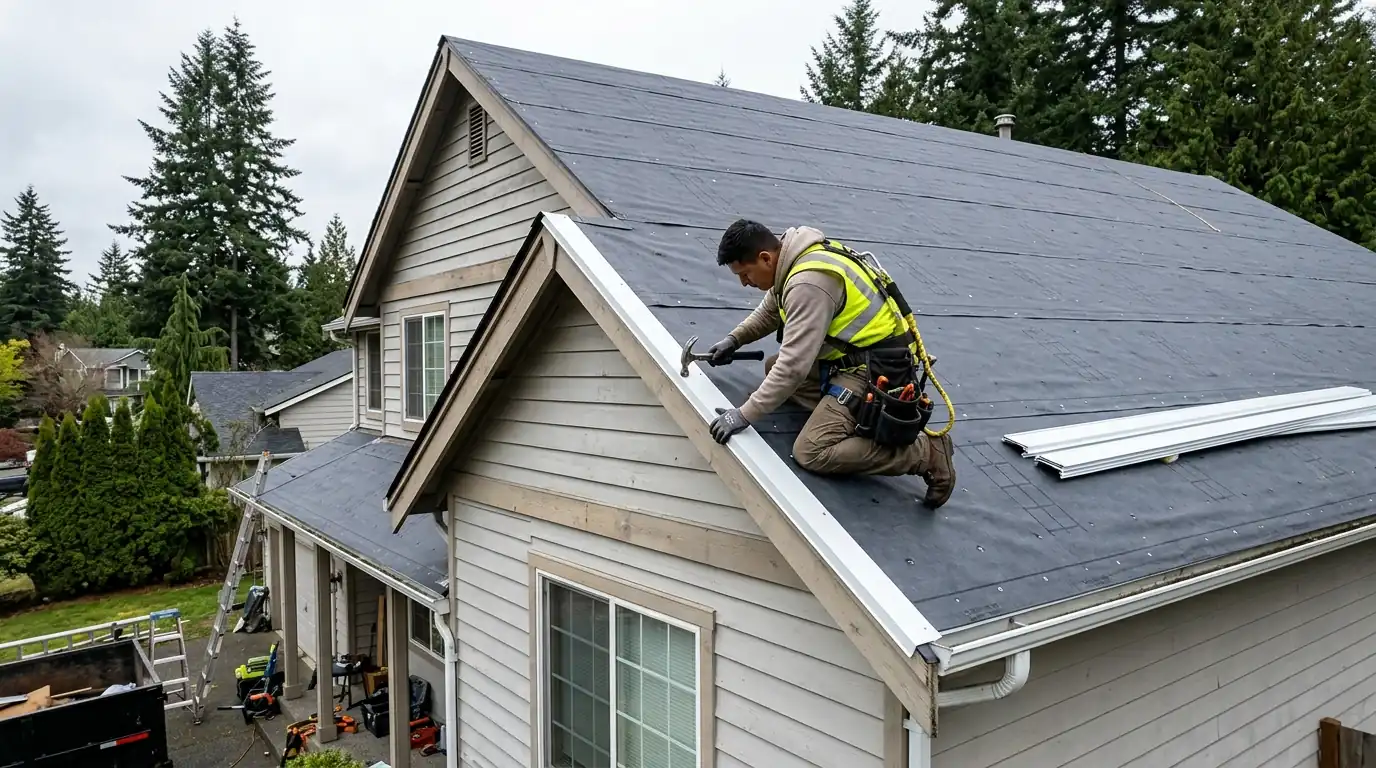
Puyallup is home base for us, and reroofs here follow City of Puyallup rules: an inspection before cover when sheathing, structure or insulation is replaced, and drip edge on every roof edge. The 1980s and 1990s were the city's biggest building decades, so many roofs we replace sit on houses from that period.
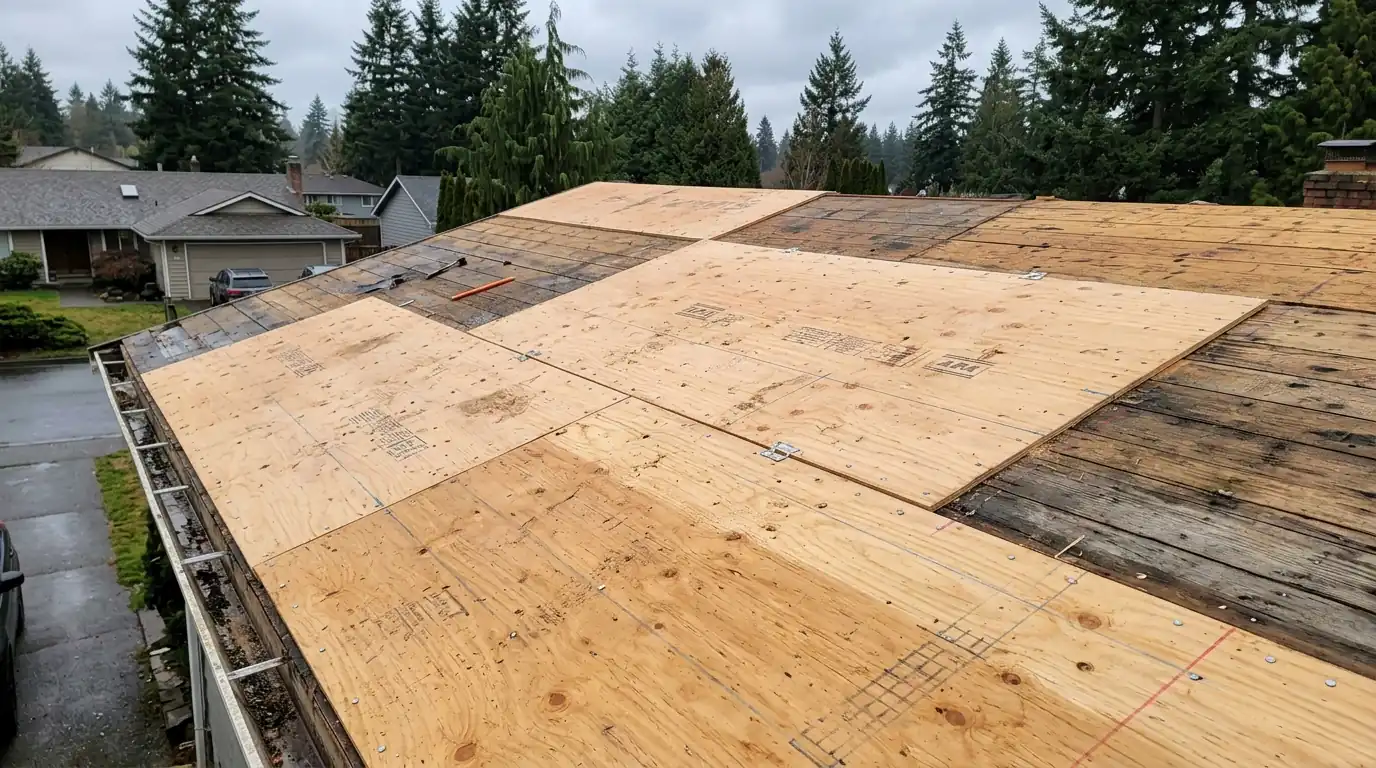
City of Puyallup reroof permits call for an inspection before cover whenever sheathing is replaced, structure is repaired or insulation is added. In practice that means a pause in the job. Once the old roof is off and any new decking or framing is in, the inspector sees it before underlayment goes on, and only then do we close it up.
We plan the tear-off around that stop. Sections are opened in a sequence we can protect overnight, and we keep tarps on site if the inspection lands on a wet day. Expect the schedule to allow for it rather than treating the inspection as a surprise.
The city also requires drip edge on all roof edges. That metal strip at the eaves and rakes keeps water from wicking back into the fascia and directs it into the gutter. On older Puyallup roofs we often find none at all, or a strip only along the eaves, so the rakes have been rotting quietly for years.
The 1990s account for 17.2% of Puyallup's homes and the 1980s for 16.4%. A roof on a house from those decades is either an original that is well past its prime or a first replacement that may have been laid over the original. We check the layer count at the eaves before we quote, because two layers change disposal, weight and how the new drip edge sits.
Those houses tend to share a few weak points worth inspecting: box vents with no matching intake, pipe boots that cracked in the sun, and valleys that were cut tight and now hold debris. A smaller group, 7.1% of the city's homes, predates 1940. Those need a slower look at plank sheathing, chimneys and the way old additions tie into the main roof.
Owner occupancy runs at 52.1%, so we also work on plenty of rentals. For landlords, we write up what we find in plain terms so a repair-or-replace decision does not depend on a tenant's description.
A reroof is the right moment to look at the gutters. If the drip edge is new and the gutter behind it is sagging or pitched wrong, water still ends up on the fascia. We often pair a Puyallup reroof with new gutters sized to the roof area above each run, especially below valleys where two planes pour into one corner.
In the fall, needles and leaves fill gutters just as the heaviest rain arrives. A cleaning in October, before November's downpours, saves most of the overflow calls we get in winter.
Tear-offs here are planned around the city's inspection before cover.
DetailsMissing drip edge at the rakes is one of the most common faults we find.
DetailsNew gutters sized to each eave keep water off fascia the new drip edge protects.
DetailsSoft decking triggers the inspection stop, so we price it per sheet up front.
DetailsOlder Puyallup houses with masonry chimneys often leak at the counter flashing.
DetailsShaded roofs hold moss through the wet months and lift shingle edges.
DetailsYes. Our office is in Puyallup, and we work on homes across the city and the rest of Pierce County. Call any hour to set up a visit.
City permit documents call for an inspection before cover when sheathing is replaced, structural repairs are made or insulation is added. Confirm current rules with the city's permit office.
City of Puyallup reroof permits require drip edge on all roof edges, which means the rakes as well as the eaves. We include it on every Puyallup reroof.
If they are sound and pitched right, yes. We pull them carefully or work around them. Sagging or leaking gutters are cheaper to replace while the roof edge is open.
Many sit on 1980s and 1990s houses, the city's biggest building decades. The roof's condition, not its age, decides whether repair or replacement makes sense.
Or see the full South Sound coverage overview.
Call any hour. Tell us the street and what you are seeing, and we will set up a visit.
Calls are answered around the clock. Tell us what you are seeing and where the house is, and we will set up a visit.
Our office sits in Puyallup, and our crews work across Tacoma and Pierce County. The map loads only when you ask for it.