Metal roofing in Tacoma: standing seam for houses, ribbed panels for shops
Metal sheds rain fast, resists moss better than most roofs and weighs less than shingles. It also costs more, and it is not the right look for every house.
- Answering 24/7
- Puyallup office
- Tacoma and Pierce County
Short answer
Metal roofing on a Tacoma house usually means standing seam: panels with raised seams locked over hidden clips, so no fastener pierces the surface water runs across. Exposed-fastener panels cost less and suit shops and outbuildings, but every screw washer is a future leak point that needs checking. Both shed rain quickly and resist moss better than shingles.
Where metal earns its higher price
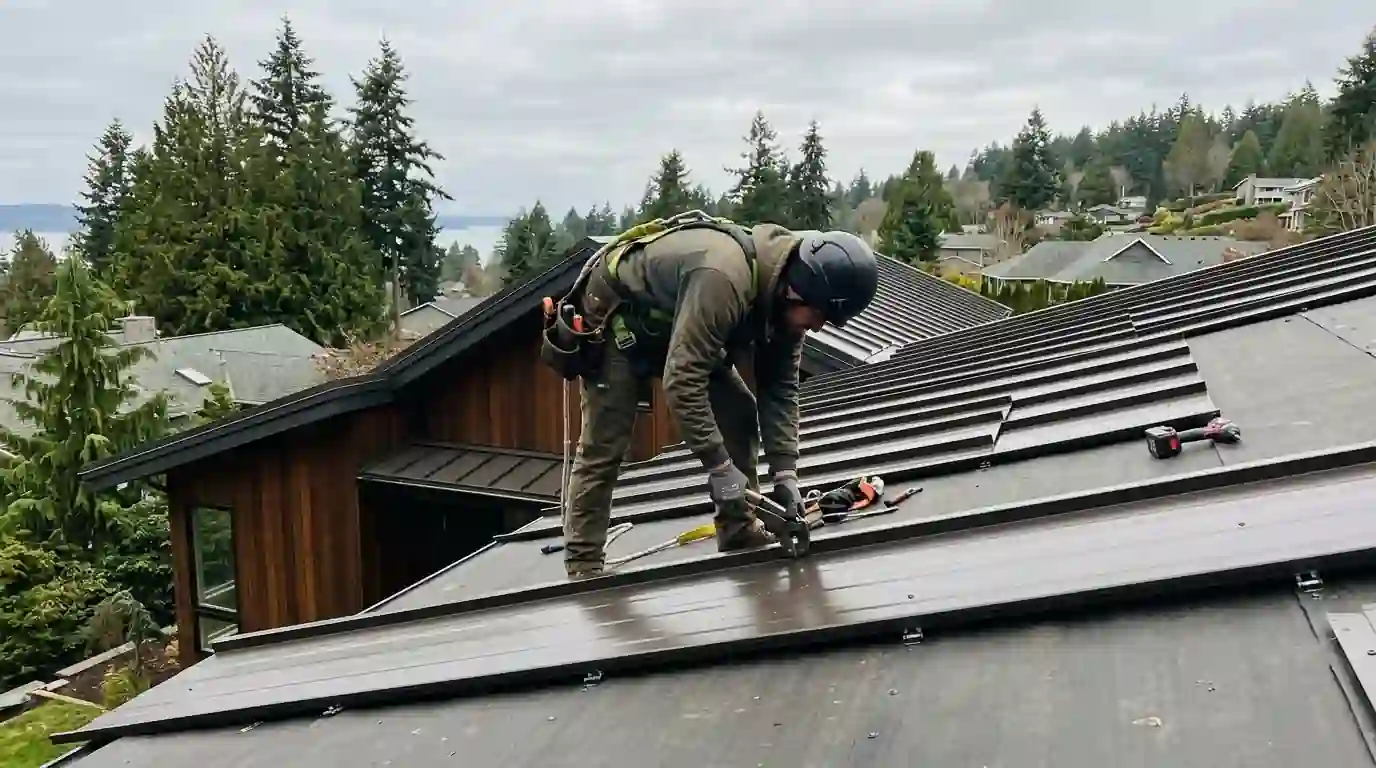
The case for metal rests on how long it lasts and how little it holds onto. Water and needles slide off, moss struggles to root, and the panels weigh less than most shingle roofs. The price is higher up front, and the install is less forgiving: panels must be measured, cut and flashed precisely, and the trim details make or break the look.
We work with panels from mills like AEP Span, Taylor Metal and McElroy Metal, in painted steel with PVDF finishes, plus aluminum where salt air is a concern. If you are still deciding between metal and shingles, our metal versus asphalt guide lays out the tradeoffs.
What goes into the price of a metal roof
Metal is priced by panel type, gauge and how much custom trim the roof needs. The published ranges below are Seattle-area figures.
Published range, not a quote and not our price. Source: angi.com, 2026-07. Your number depends on the factors below and is set after we see the roof.
Panel system
Standing seam costs well above exposed-fastener panels.
Gauge and finish
Thicker steel and premium paint finishes add cost.
Roof complexity
Every valley, dormer and penetration needs custom trim.
What comes off first
Tear-off and any deck repair are part of the price.
Underlayment
High-temperature underlayment under metal costs more than felt.
Standing seam or exposed-fastener panels
Both are metal roofs. They differ in how they are fastened, and that drives everything else.
| Item | Standing seam | Exposed-fastener |
|---|---|---|
| Fasteners | Hidden clips under the seams | Screws through the panel face |
| Upkeep | Little | Periodic screw and washer checks |
| Look | Flat pans and raised seams | Ribbed or corrugated |
| Cost | Higher | Lower |
| Typical use | Houses and visible roofs | Shops, barns, carports |
Standing seam
Standing seam panels run from eave to ridge in one piece, with their seams raised above the water line and locked together. Clips under the seams hold each panel down while letting it expand and contract, which keeps fasteners from working loose over the years. Snap-lock panels suit most houses; mechanically seamed panels, crimped with a seaming tool, hold up better on low slopes and exposed sites. Details matter most at valleys, walls, chimneys and skylights, where trim must be folded rather than caulked. The tradeoff is cost, since standing seam is the most expensive common roof we install.
Exposed-fastener panels
Ribbed or corrugated panels screw straight through the face into purlins or solid decking, with a rubber washer under each screw head. They go on quickly and cost far less than standing seam, which is why they are common on barns and shops. The weak point is those washers. Sun and temperature swings break them down, and screws loosen as the panels move. Plan on inspecting and replacing failed screws every several years. On a house we usually steer people toward standing seam; on a pole building or carport, exposed-fastener panels are often the sensible spend.
Metal for shops and outbuildings
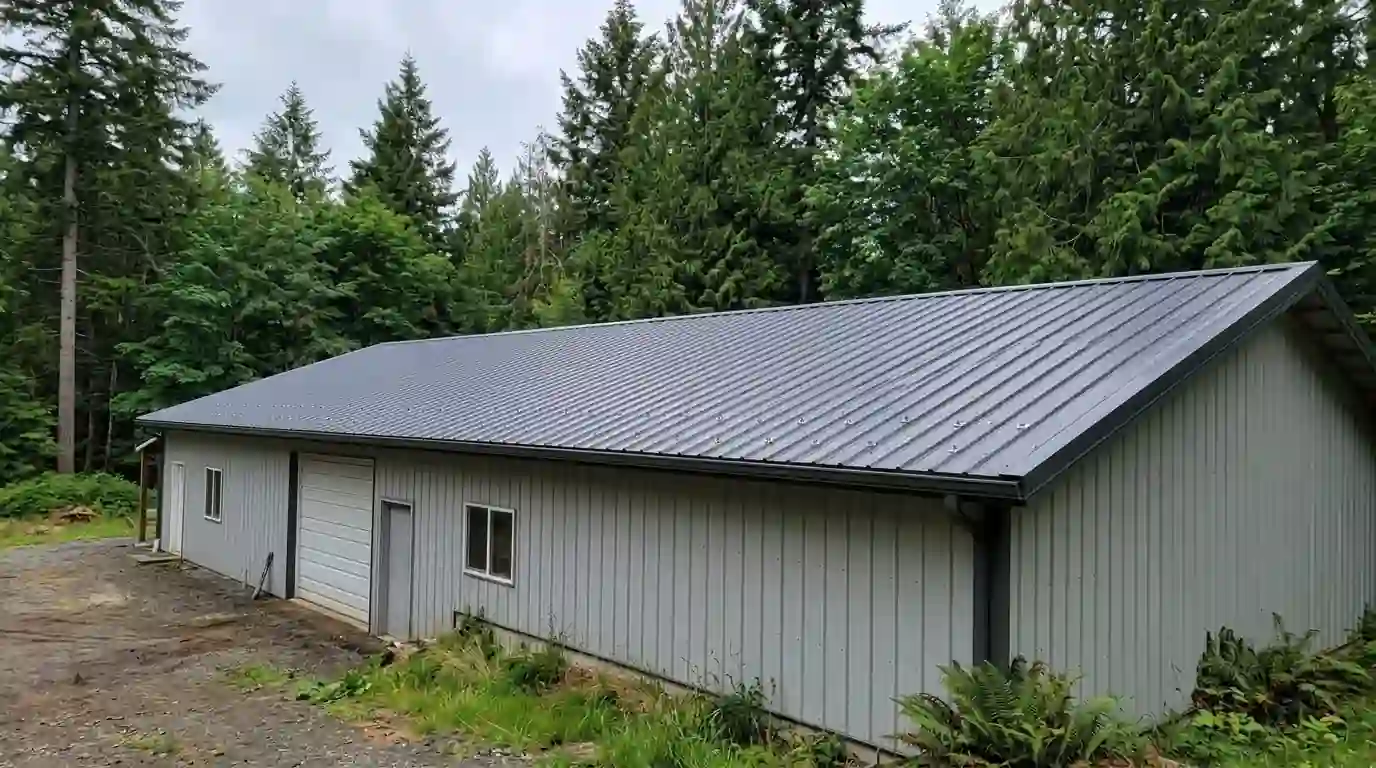
Shops, garages, barns and sheds are where metal makes the most sense on many properties. Long panels cover a big, simple roof fast, need little upkeep and handle lower pitches with the right system. On older pole buildings we check purlin spacing and condition before new panels go on. Heated shops get a condensation-control backing or vapor barrier so moisture does not drip from the underside, and doors get snow and debris guards above them. A metal roof is often lighter than the old covering it replaces, which keeps the structure question simple.
Metal on historic homes
Metal can look right on a farmhouse or a modern build, but on many older Tacoma houses it changes the character of the roof. In local historic districts the guidelines matter more than taste, and some rule out metal on historic homes entirely. Where metal is acceptable, a narrow-rib standing seam in a muted color, with low-profile trim, reads closest to a traditional roof. Porches and bay windows on older houses sometimes carried metal originally, and those small roofs can be a good fit. We check the district rules before pricing metal on any older house.
How we put on a metal roof
We check the district and permit
Historic rules and permit needs come first.
We measure precisely
Panel lengths and trim are planned before ordering.
We prepare the deck or purlins
Old roofing off, repairs made, underlayment down.
We set eave and valley trim
Base flashings go in before any panel.
We hang the panels
Clips or screws on the maker's spacing, square to the eave.
We trim walls and penetrations
Folded flashings around pipes, chimneys and walls.
We close the ridge
Vented closures and ridge cap finish the roof.
Tacoma and Pierce County
Historic limits and county permits for metal
On the North Slope and in the Wedge, the historic district guidelines accept composition roofing as a substitute for shingles but state that metal roofs are not acceptable for historic homes. If your house sits in either district, we will point you to composition instead. Outside the city, Pierce County needs no building permit to re-roof a home or garage steeper than 2:12 when coverings total 7.5 lb/sq ft or less, so a light metal reroof on a house or garage in South Hill, Spanaway or Graham may not need one. Replacing sheathing is not exempt.
- AEP Span
- Metal Sales
- Fabral
- McElroy Metal
- Taylor Metal
- Drexel Metals
- Sheffield Metals
- Union Corrugating
Metal Roofing questions from Tacoma homeowners
Over solid decking and underlayment, rain sounds much like a shingle roof. Panels on open purlins are louder, which matters more on a shop than a house.
Some systems allow it, but it hides deck problems and traps old moisture. On most houses we tear off first.
Far less than on shingles, because there is little texture for it to root in. Debris in valleys and shaded edges can still hold some.
No. Metal does not make a strike more likely, and it will not burn if one happens.
Not on historic homes in some Tacoma districts. Our historic district guide explains the rules.