Reroofing a house in a Tacoma historic district
Historic district guidelines shape what goes on a roof long before a shingle is ordered. Here is what Tacoma's published guidelines say and how we plan around them.
By Kathleen Peabody, Roofing Guides Editor · Updated October 2026
- Answering 24/7
- Puyallup office
- Tacoma and Pierce County
Short answer
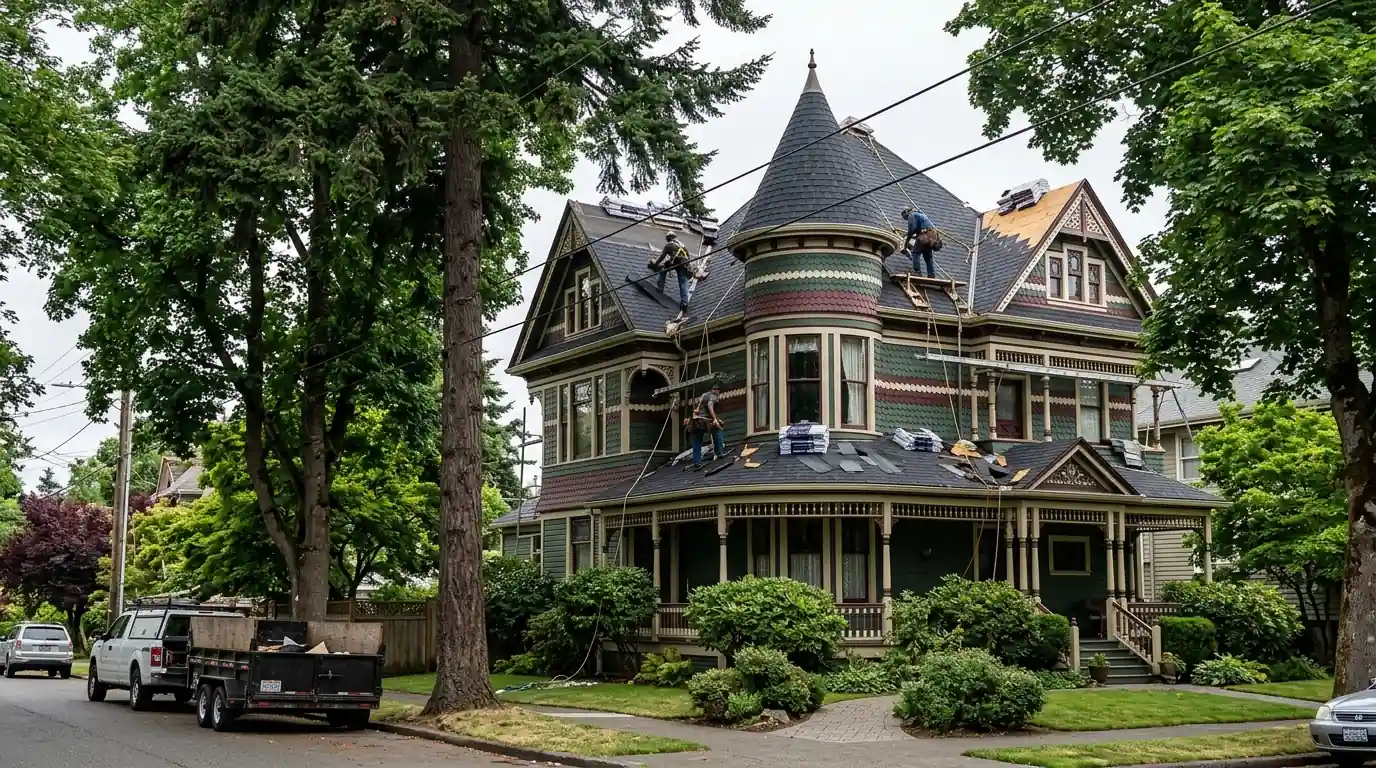
A Tacoma historic district reroof usually means composition or wood shingles, not metal. The North Slope and Wedge guidelines accept composition roofing as a substitute for shingles but state metal roofs are not acceptable for historic homes. A single-layer composition reroof may skip design review, while other roof types may need Landmarks Commission review.
Which Tacoma districts and houses this applies to
Tacoma has four local historic overlay districts, and visible exterior work on landmarks or contributing properties generally needs design review. The North Slope Historic District alone has over 900 homes built between 1881 and 1955. The smaller Wedge district has about 70 homes dating from early Tacoma to just after World War One.
The Stadium-Seminary Historic District developed between 1888 and 1930, led by Queen Anne and Colonial Revival homes, with Tudor, Chalet, Bungalow and Mediterranean styles mixed in. Most of the specific rules in this guide come from the City of Tacoma's North Slope and Wedge design guidelines, so owners elsewhere should ask the city which guidelines govern their street.
When does a reroof trigger design review?
The North Slope and Wedge guidelines describe the simplest case. A single-layer composition reroof with sheathing may not need a building permit and so skips design review. Other roof types may need review by the Landmarks Commission.
In practice, design review becomes likely when the work changes what people see from the street. A switch to a different material, a new dormer, a change in pitch or the removal of a chimney all fall into that group. Skylights on a street-facing slope deserve a question too.
None of this is legal advice. The city's historic preservation staff decide how the guidelines apply to your house, so confirm with them before you settle on a material or a design. Our reroof permit guide covers the building permit side.
Roofing materials the guidelines accept
The North Slope and Wedge guidelines accept composition roofing as a substitute for shingles. Many of these houses were first roofed in wood shingles, and a composition roof gives a similar texture at the scale people see from the sidewalk.
Within composition, we lean toward products that keep the look quiet: a dimensional shingle with a modest shadow line, and a color that suits the siding and trim rather than standing out. Ridge caps, hip caps and the way the shingles wrap a turret or curved bay all affect how the finished roof reads from the street.
If you want to restore wood shingles, ask the city early. Wood roofing on a historic house is a different conversation from composition, and the review path may be longer.
Why metal is off the table for historic homes
The guidelines state plainly that metal roofs are not acceptable for historic homes. That includes standing seam, which many owners consider for its long life and its resistance to moss.
The reasoning is visual. Metal panels produce long, straight seams and a sheen that did not exist on these houses when they were built, and they change the character of a streetscape. If metal is your goal, this is the rule to know before any design work begins. Our metal versus asphalt guide covers the tradeoffs for homes outside the districts.
Roof details that matter on older houses
A house from the late 1800s or early 1900s rarely has a simple roof. We plan for these details before the first shingle comes off:
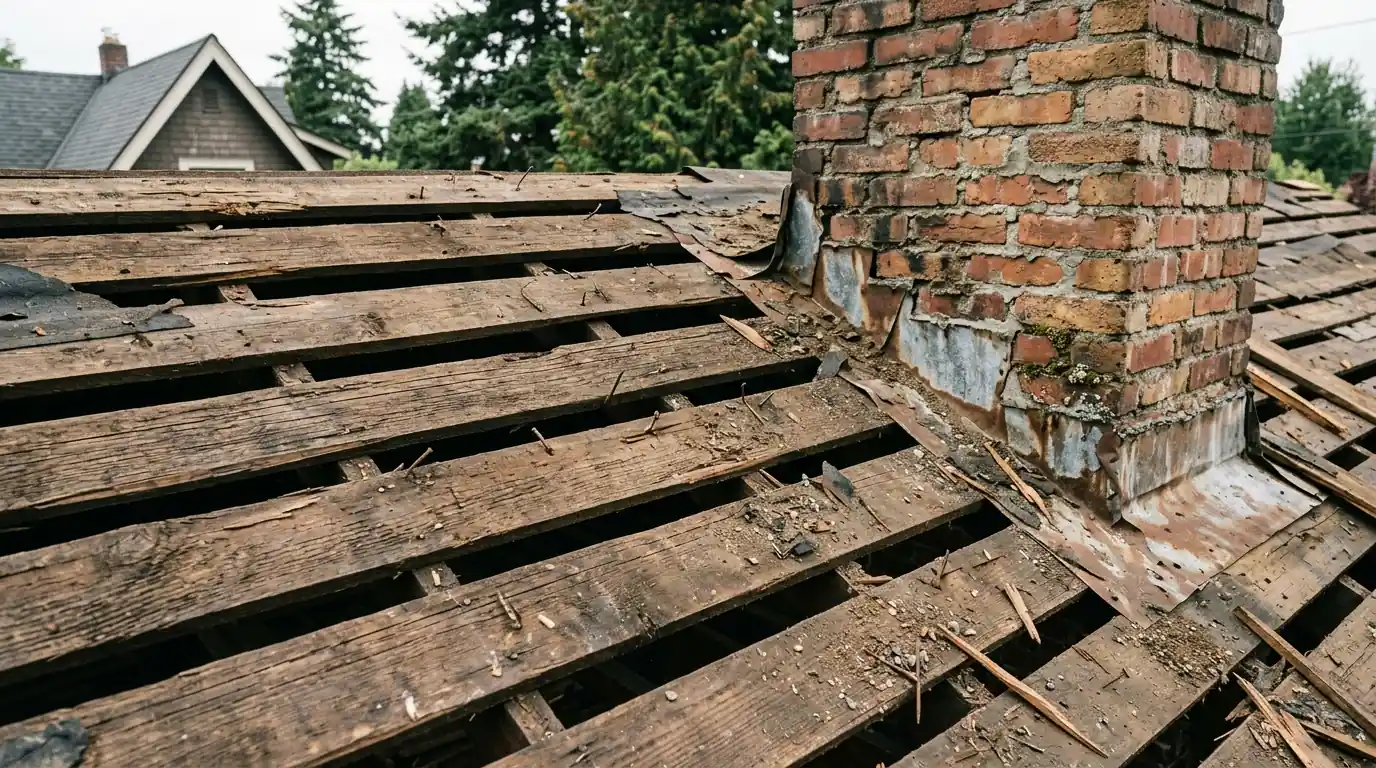
- Spaced plank decking built for wood shingles
- Built-in or box gutters hidden behind the fascia
- Brick chimneys with aging mortar and old flashing
- Turrets, curved bays and steep dormers
- Several layers or old shakes under the current roof
- Decorative trim and cornices to protect during tear-off
Want a second pair of eyes?
We answer 24/7. Call (253) 449-1922 and describe what you are seeing.
Siding repairs: fix the failure, keep the original
Roof work often uncovers siding problems at walls, dormers and eaves. The guidelines ask owners to repair small siding failures rather than strip large areas of original siding.
That matches how we approach older wood siding anyway. A rotted board below a leaking step flashing can be cut out and replaced with a matching profile, and the sound boards around it stay. Stripping a whole wall to fix one corner loses original material that cannot be replaced, and it creates more work than the problem needs. Our siding repair work follows that same approach.
Windows: why vinyl replacements get rejected
The same guidelines reject vinyl windows as replacements for historic windows. Owners sometimes plan a roof, siding and window project together, and this is the point where plans most often change.
Old wood windows can often be repaired: new glazing putty, freed sashes, weatherstripping and sound sills. Where a window is beyond repair, ask the city what replacement it will accept before ordering anything, since lead times on custom windows are long.
How we plan a historic district reroof
These houses reward planning. This is the order we work in:
- Confirm the district and contributing status with the city
- Inspect the roof, attic, chimneys and gutters
- Choose a material and color the guidelines accept
- Find out whether design review or a permit applies
- Schedule tear-off for a dry stretch of weather
- Repair decking, flashing and trim as found
- Keep original siding and windows unless the city agrees otherwise
Questions readers ask
The North Slope and Wedge guidelines state metal roofs are not acceptable for historic homes. Confirm with the city, but plan on composition or wood shingles.
A single-layer composition reroof with sheathing may not need a building permit and so skips design review. Other roof types may need Landmarks Commission review.
Tacoma has four local historic overlay districts, including North Slope, Wedge and Stadium-Seminary. The city can confirm whether your property is a landmark or contributing home.
The North Slope and Wedge guidelines reject vinyl windows as replacements for historic windows. Repair is often possible, and the city can say which replacements it accepts.
The guidelines ask owners to repair small siding failures rather than strip large areas. We replace the rotted boards with a matching profile and keep the sound ones.
Yes. We reroof and repair older houses across the North Slope and Stadium District. See our North Slope page for that neighborhood.