Fiber cement or vinyl siding for a western Washington house
Both sidings work in a wet climate when the wall behind them is built right. The differences are in paint, impact, heat, looks and how each fits an older house.
By Kathleen Peabody, Roofing Guides Editor · Updated October 2026
- Answering 24/7
- Puyallup office
- Tacoma and Pierce County
Short answer
For most Tacoma houses, fiber cement handles the wet climate well and holds paint for years, while vinyl costs less and never needs painting. Either one works only over a sound wall with house wrap, flashing and a way for water to drain. Tacoma averages about 40.81 inches of rain a year, so the wall behind the siding matters as much as the panel.
How each siding handles 155 wet days a year
Tacoma's climate table shows roughly 155 precipitation days a year. No siding keeps all of that water out. Wind pushes rain through joints, around windows and behind trim, so every siding is really the first layer of a system that must let water drain back out.
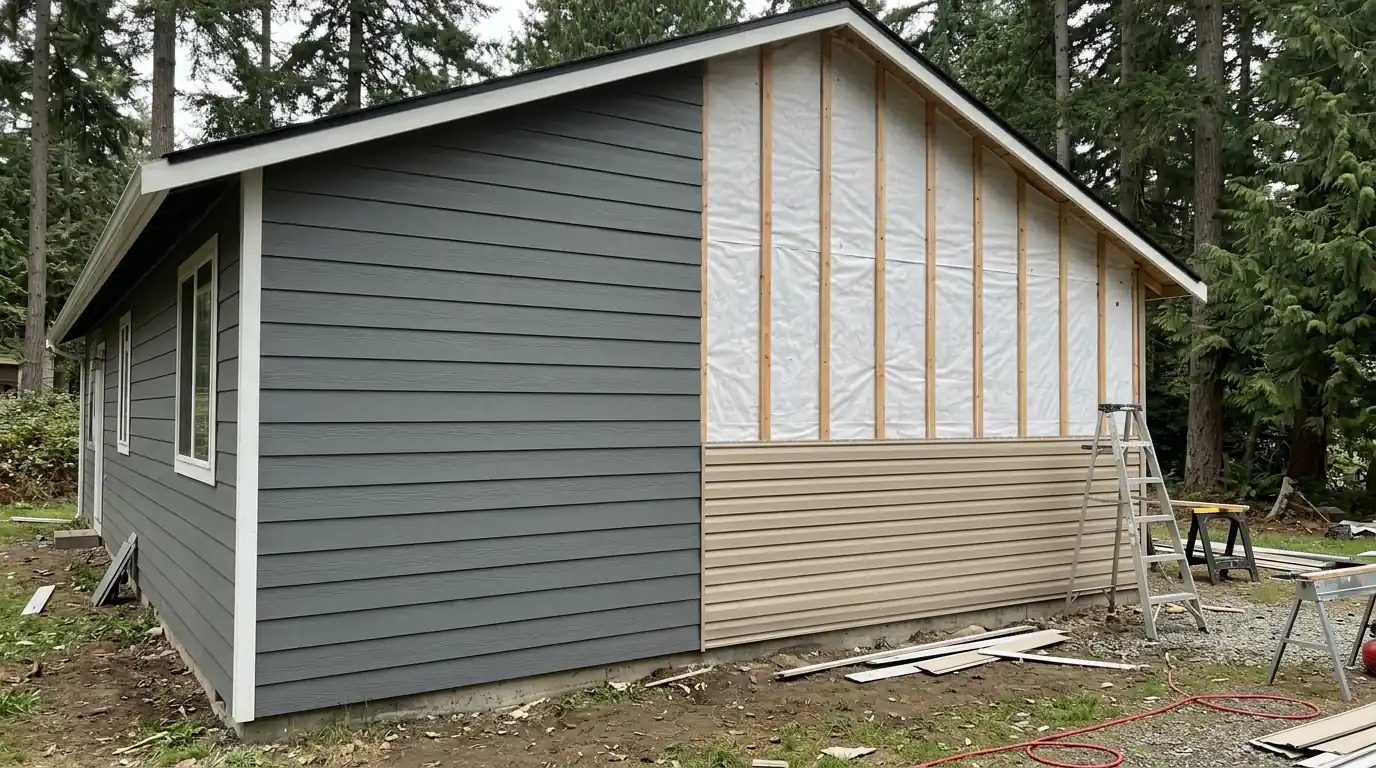
Fiber cement is a board made of cement, sand and wood fiber. It does not rot, swell much or feed mold, but its cut edges and the bottom edge can wick water if they are left unsealed or sit too close to a roof or the ground. Vinyl does not absorb water at all. It is hung loosely so it can move with temperature, and that loose fit lets water get behind it as well as drain out.
Rainscreen: the gap behind the siding
A rainscreen is a small air gap between the siding and the house wrap, made with thin furring strips or a textured drainage mat. Water that gets past the siding runs down the gap and out the bottom, and the air movement dries the back of the boards and the wrap. On a western Washington wall, that gap does more for longevity than the choice of siding.
Fiber cement benefits the most, because it is laid tight to the wall and has no built-in drainage. Vinyl panels already stand off the wall a little and have weep holes, so they behave like a rough rainscreen on their own. Both still need sound house wrap, flashing over windows and doors, and kick-out flashing where a roof edge meets a wall.
Fiber cement and vinyl compared side by side
This table sums up how the two compare on the things homeowners ask about most.
| Item | Fiber cement | Vinyl |
|---|---|---|
| Water in the board | Does not rot; seal cut edges | Absorbs none |
| Drainage behind it | Needs a rainscreen gap to dry well | Loose fit drains on its own |
| Paint | Factory finish or field paint, repainted over time | Color goes through, no paint needed |
| Impact and wind | Hard, resists dents and wind | Can crack in cold or blow loose |
| Heat | Stable | Can warp from reflected sun |
| Fire | Does not burn | Melts and burns |
| Repairs | Single boards cut in and painted | Panels can be swapped, if color matches |
| Look on older homes | Can mimic lap and shingle wood | Reads as vinyl up close |
Paint and color over the years
Fiber cement holds paint far longer than wood because it does not swell and shrink with moisture. You can buy it factory finished, as with James Hardie's prefinished lines, or primed for painting on site. Either way it can be repainted any color later, which matters if you plan to change the look of the house.
Vinyl's color runs through the panel, so scratches do not show and there is nothing to repaint. The tradeoff is that color is fixed. Darker vinyl colors absorb more heat, and painting vinyl later limits you to vinyl-safe paint colors that will not cause warping. If a crisp painted finish on trim matters to you, fiber cement or engineered wood like LP SmartSide gives you more control.
Want a second pair of eyes?
We answer 24/7. Call (253) 449-1922 and describe what you are seeing.
Siding on houses in Tacoma historic districts
Tacoma has four local historic overlay districts, and visible exterior work on landmarks or contributing properties generally needs design review. The City of Tacoma's North Slope and Wedge design guidelines ask owners to repair small siding failures rather than strip large areas of original siding, and they reject vinyl windows as replacements for historic windows.
For an older house in one of those districts, the starting point is repair: replacing rotted boards with matching wood and fixing the flashing that let water in. Before you plan any replacement siding, confirm with the City's historic preservation office what review applies. Our guide on reroofing in a Tacoma historic district covers the roof side, and siding repair covers matching older siding.
What new siding costs in the Seattle area
The sourced range below is a Seattle-area planning figure that splits out fiber cement and vinyl by the square foot. Wall area, stories, trim detail and how much rot turns up under the old siding move the final number more than the siding type does.
Published range, not a quote and not our price. Source: angi.com, 2026-08. Your number depends on the factors below and is set after we see the roof.
Which siding fits which house
Fiber cement makes sense on houses you plan to keep, homes with a painted or traditional look, and walls near trees or play areas where vinyl would crack or dent. It is heavier and slower to install, so it costs more, but it wears the climate well over a long time.
Vinyl fits rentals, tight budgets and newer homes where a low-upkeep finish matters more than paint options. Whichever you choose, we strip enough to check the sheathing, fix dry rot, and flash every window before the new siding goes on. See siding installation for the full scope.
Questions readers ask
It is not always required, but we recommend one on most walls here. The gap lets water drain and the boards dry, which protects the paint and sheathing.
Vinyl itself does not trap water; it drains through weep holes. Trouble comes from torn house wrap or missing flashing behind it, which is why we check those.
Sometimes, but we rarely advise it here. Covering old siding hides rot and flashing problems, and it makes window and trim details harder to get right.
Factory finishes and good field paint hold up much longer on fiber cement than on wood, because the board stays stable. Sun exposure decides the repaint cycle.
Check with the City's historic preservation office first. The North Slope and Wedge guidelines favor repairing original siding over stripping large areas.
Single boards can be cut out and replaced, then painted to match. Prefinished colors may need touch-up paint from the maker to blend.