Do gutter guards work under fir trees? What holds up to needles
Fir and pine needles are the hardest test a gutter guard faces. Some guards pass it and most do not, and even the good ones still need a little care.
By Kathleen Peabody, Roofing Guides Editor · Updated October 2026
- Answering 24/7
- Puyallup office
- Tacoma and Pierce County
Short answer
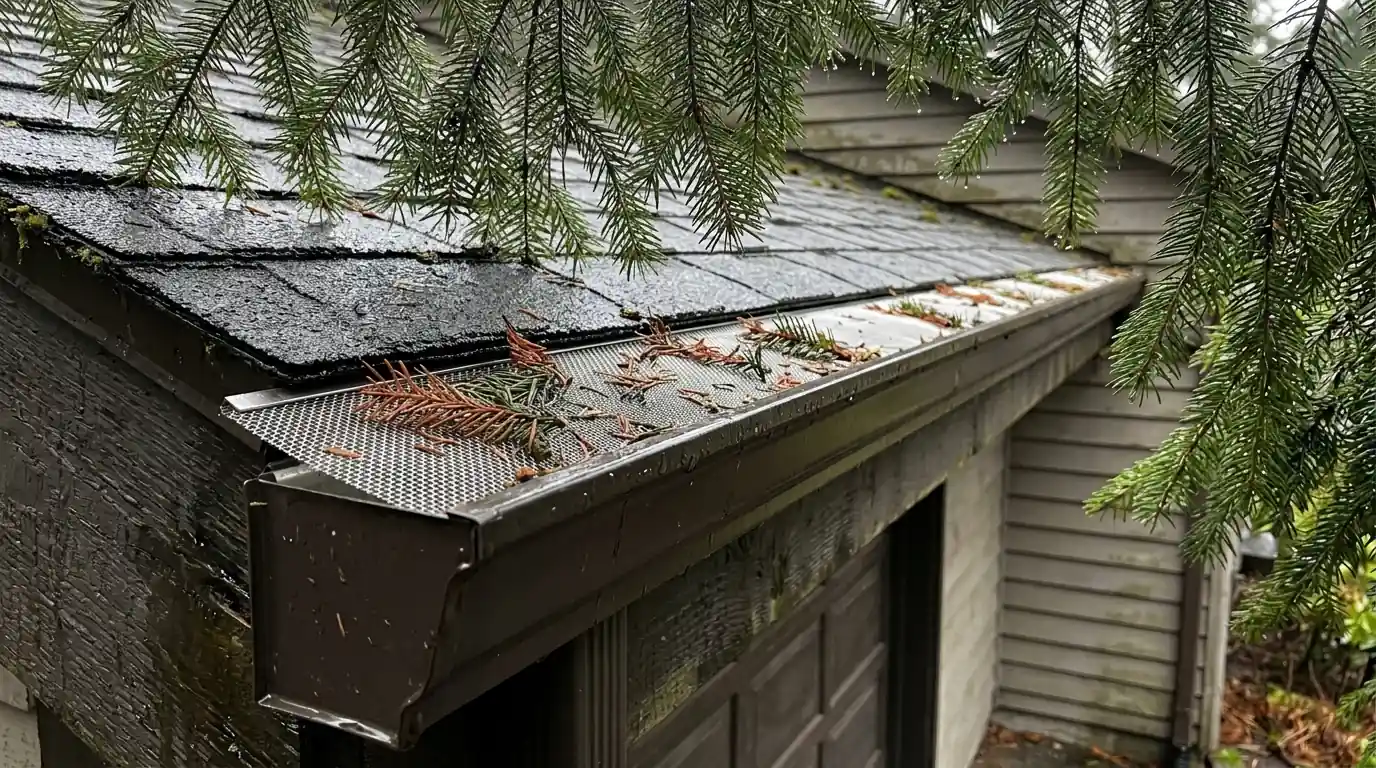
Gutter guards do work under fir trees in Tacoma, but only fine micro-mesh stops needles reliably, and it still needs brushing off once or twice a year. Fir and pine needles slip through screens and foam inserts and pile up on reverse-curve hoods. November, the wettest month at 6.31 inches, is when a clogged guard sends water over the front.
Why fir and pine needles beat most guards
Leaves are wide and flat, so almost any guard sheds them. Needles are thin, stiff and short, which lets them slide through openings that stop a maple leaf. Once a few needles wedge into a screen, they catch the next ones, and in a couple of seasons the guard is matted shut while the gutter below fills with the fine stuff that slipped through.
Needles also fall nearly all year. Douglas fir and pine shed through fall and winter storms and again after summer dry spells, so a guard has no quiet season to catch up. That makes the size of the opening, and what happens to needles that land on top, the two things that decide whether a guard is worth buying.
How much tree canopy hangs over Tacoma roofs
The City of Tacoma's 2017 LiDAR survey put tree canopy at about 20% of the city's land, with census blocks ranging from 3% to 64%. That range is the whole story for gutters. A house in a low-canopy block may never need a guard, while a house in a heavily treed block can clog a gutter in a single storm.
Canopy is set to grow, not shrink. The city's urban forest plan targets 30% canopy by 2030, and residential property already holds 44% of the current canopy. More trees over yards means more needles in gutters over the coming years, which is worth weighing if you are deciding whether to guard a gutter now or keep cleaning it.
Gutter guard types compared under needles
Here is how the common guard types behave under fir and pine, based on what we find when we pull them off or clean them.
| Item | Stops needles | What builds up | Upkeep under firs |
|---|---|---|---|
| Stainless micro-mesh | Yes, openings are too fine | Needles and moss dust on top | Brush or blow off once or twice a year |
| Perforated aluminum | Partly, needles stick in holes | Needles wedged upright | Clear holes each fall |
| Plastic or wire screen | No, needles pass and mat | Mats on top, sludge below | Remove and clean the gutter |
| Foam or brush insert | No, needles lodge inside | Packed needles and seedlings | Pull out and wash yearly |
| Reverse-curve hood | Partly, needles ride over | Needle piles on the lip | Clear the lip and gutter |
What still needs cleaning with guards on
A guard moves the cleaning job; it does not end it. Micro-mesh keeps needles out of the trough, but needles and moss bits collect on the mesh surface, and in heavy rain water can sheet over a coated mesh instead of dropping through. Most of our guarded gutters under firs need a light clearing once or twice a year.
- The mesh surface, brushed or blown clear
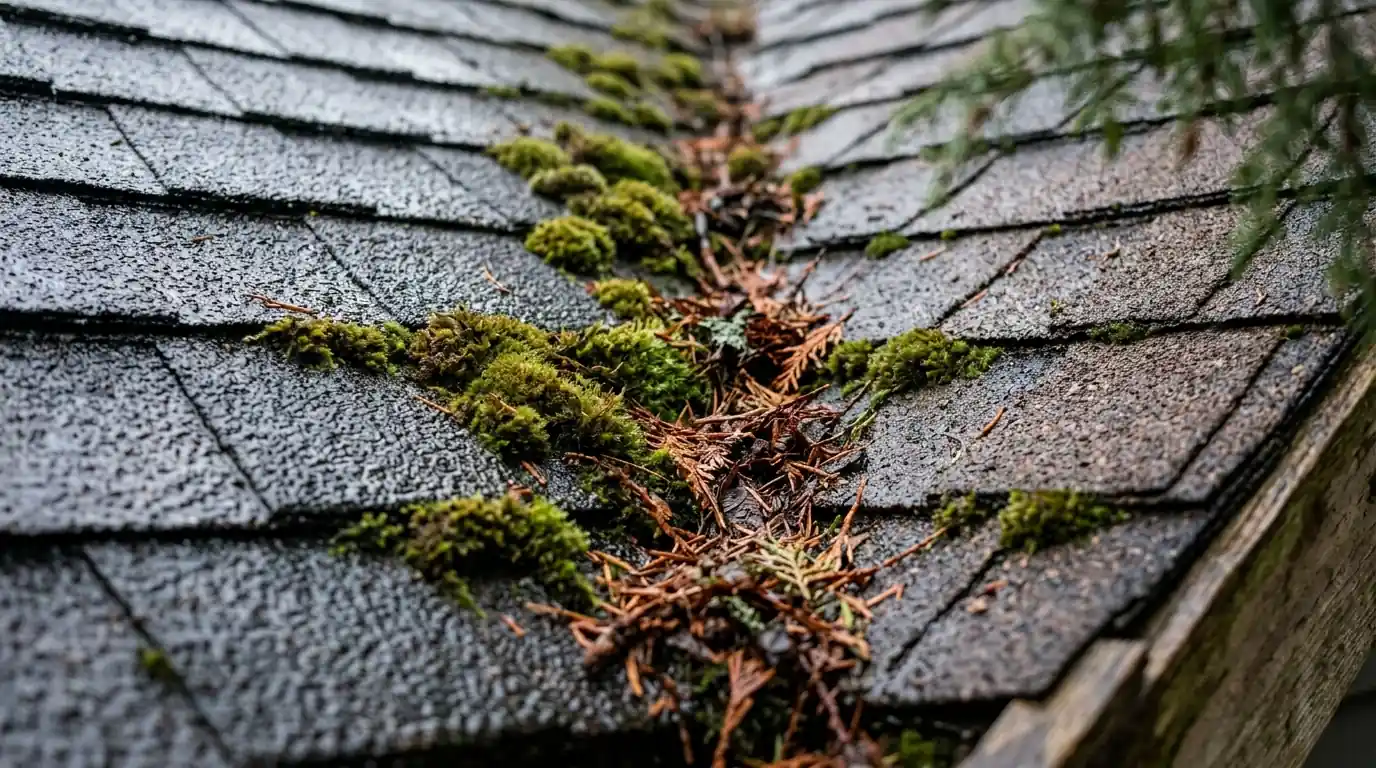
- Roof valleys, where needles pile and spill into one corner
- Downspout tops and elbows, which still collect fine grit
- The first few feet behind each outlet
- Any section where a branch rubs or drips onto the guard
Want a second pair of eyes?
We answer 24/7. Call (253) 449-1922 and describe what you are seeing.
Moss, zinc strips and guards on the same roof
Shade that drops needles also grows moss. Oregon State University Extension notes that roof moss follows shade, holds moisture and can lift shingles, and that trimming trees is the long-term fix. Moss that breaks loose in winter rain washes down as a fine green paste that coats mesh and slows it down, so a mossy roof shortens the time between guard cleanings.
If you use zinc strips or a zinc moss treatment, check what your gutters are made of. The same OSU guidance says zinc corrodes copper gutters, so zinc above copper is a poor pairing. Our moss removal page covers other options, and our guide on moss on Tacoma roofs goes further.
What gutter guards cost around Seattle and Tacoma
Guards are priced by the linear foot, so a long single-story ranch and a compact two-story house can land close together. The sourced range below is a Seattle-area planning figure. Micro-mesh sits toward the upper end, while screens and foam inserts sit lower, though under firs the cheaper types tend to cost more in cleaning over a few years.
Published range, not a quote and not our price. Source: angi.com, 2026-08. Your number depends on the factors below and is set after we see the roof.
When gutter guards are not worth it
A guard is only as good as the gutter under it. If the gutter is undersized for the roof, sags or leaks at the corners, a guard will not fix overflow, and installing one makes repairs harder. In those cases we fix or replace the gutter first; see gutter repair and gutter installation.
Guards also make less sense where only one short run sits under a tree, or where the tree is coming down soon. A few planned cleanings a year can cost less than guarding the whole house. Our gutter cleaning visits include the valleys and downspouts either way.
Questions readers ask
The mesh itself rarely clogs through, but needles and moss dust collect on top. Brushing the surface once or twice a year keeps water dropping through it.
Snap-in screens are simple to fit from a ladder. Micro-mesh needs to sit at the right angle under the shingle edge or on the gutter lip, or water overshoots it.
No. Ice dams come from heat escaping the attic and melting snow on the roof. Guards do not change that, though they can hold snow at the eave.
Some guards slide under the first shingle course, which some shingle makers discourage. We fit guards that attach to the gutter lip on roofs where that matters.
Look from the ground after the fall storms and again in spring. If water sheets over the front during rain, the mesh needs clearing.
Trimming branches back from the roof cuts needle load and moss together. Many homes need both: some trimming and a fine mesh guard for what still falls.