Roof leaking in a downpour: what to do in the first hour
The first hour of a roof leak is about the room, not the roof. These steps keep a drip from turning into a ceiling repair while you wait for help.
By Kathleen Peabody, Roofing Guides Editor · Updated October 2026
- Answering 24/7
- Puyallup office
- Tacoma and Pierce County

Short answer
When a Tacoma roof starts leaking in a downpour, protect the room first and find the roof problem second. Move belongings, catch the drip, cut power to any fixture near the water, and relieve a bulging ceiling before it gives way. Tacoma gets about 40.81 inches of rain over roughly 155 wet days, so a temporary fix may need to hold for weeks.
The first ten minutes: protect the room
Water spreads across a ceiling and down walls faster than most people expect, and what it soaks into costs more than the roof repair. Start with the things that cannot get wet, then deal with the drip itself.
- Move electronics, rugs and furniture away from the drip
- Put a bucket or bin under it with a towel inside to stop splashing
- Lay plastic sheeting or a shower curtain under the bucket
- Mop standing water so nobody slips
- Take photos of the ceiling and anything that got wet
Shut off power near the water
Water and wiring share the same ceiling space. If water is dripping from a light fixture, a ceiling fan or a smoke alarm, or running near an outlet, switch off that circuit at the breaker panel. Do not touch the fixture or the switch with wet hands, and keep people out from under it.
If the panel itself is wet, or you would have to stand in water to reach it, do not go near it. Leave the room and call an electrician or your power utility. A leak can wait a few minutes; a shock cannot be undone. Once the circuit is off, leave it off until the fixture has dried and been checked.
Draining a bulging ceiling safely
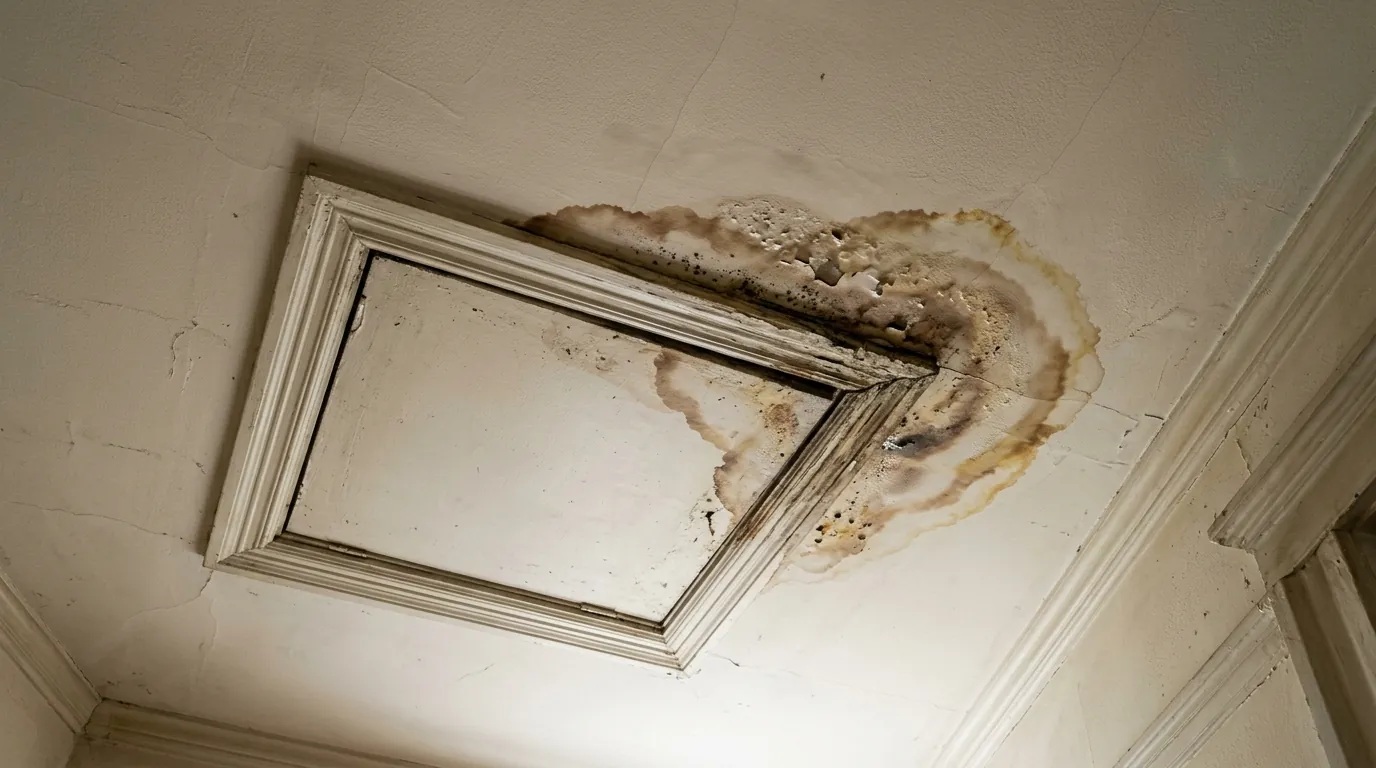
A ceiling that sags into a bubble is holding a pool of water on top of the drywall. Left alone, it can tear open all at once and drop the water, the wet board and the insulation together. Draining it on your terms is safer.
Turn off any power to the area first. Set a bucket under the lowest point of the bulge, put on eye protection, and stand to one side rather than directly underneath. Push a screwdriver gently through the drywall at the lowest point to make a small hole. Water will run out steadily; if it slows, a second small hole nearby can help. One small hole is easy to patch later. A collapsed ceiling is not.
Finding the source from the attic
If you can reach the attic safely, go up with a flashlight and step only on the framing, never between joists. Find the wet spot above the ceiling stain, then follow the water uphill. It usually runs along the underside of the roof deck or down a rafter before it drips, so the real entry point is often several feet higher and toward the ridge.
Look hardest at the usual suspects: plumbing vent pipes, the chimney, skylights, valleys and any wall where the roof meets siding. Mark the spot with tape or take a photo with something for scale. If the attic shows frost or wet nail tips everywhere rather than one trail, read our guide on attic condensation versus a leak.
Is it the roof, or water coming from somewhere else?
Not every wet ceiling under a roof is a roof leak. In Tacoma the heaviest rain arrives in late fall and winter, and November alone averages about 6.31 inches at Sea-Tac. That is when overflowing gutters, wind-driven rain at windows and attic condensation all show up at once, and each one can drip through a ceiling the same way a torn shingle does.
A few clues help sort them out. Water that appears only during a downpour, and only when the gutters are spilling over, often comes in at the wall top or fascia rather than through the shingles. A stain that shows up after a cold, still night with no rain points to condensation in the attic, which our attic condensation guide walks through. Water that runs down a window frame or wall surface during wind from one direction usually means flashing at the window or siding, not the roof field.
You do not need to solve this before you call. Telling us when the water appears, what the weather was doing and where the stain sits is enough for us to start in the right place.
Want a second pair of eyes?
We answer 24/7. Call (253) 449-1922 and describe what you are seeing.
Why you should wait for daylight to go on the roof
Do not climb onto the roof in the rain or the dark. Wet shingles are slick, moss makes them worse, and a ladder on soaked ground shifts. Work inside until the rain stops and you have daylight. If you can, place a bucket in the attic directly under the drip, sitting on boards across the joists, to take the load off the ceiling below.
Tarp now or a permanent fix?
A tarp is a temporary roof. It goes over the damaged area, runs up and over the ridge so water cannot get under the top edge, and is fastened through boards rather than with nails straight through the plastic. It buys time, not a repair. Wind works at tarps, so they need checking after each storm.
In Tacoma that time can stretch. November is the wettest month at Sea-Tac at 6.31 inches, followed by January at 5.78 and December at 5.72, so a permanent repair may wait for a dry window. The range below is a national planning figure for emergency tarping.
Published range, not a quote and not our price. Source: homeadvisor.com, 2026-06. Your number depends on the factors below and is set after we see the roof.
What to tell us when you call
We answer 24/7, and a few details help us plan the visit: where the water shows, whether it is near a light or outlet, how fast it is dripping, what you found in the attic, and roughly how old the roof is. Our emergency roof repair and roof leak repair pages explain what happens next.
Questions readers ask
It is if water is near wiring, the ceiling is bulging, or it is pouring in. A slow drip into a bucket can usually wait until daylight for a visit.
Not in the rain or on a wet roof. Sealant will not bond to wet shingles, and going up is the riskiest part. Catch the water inside and wait.
Not under a sagging or bulging section. Drain it or move to another room, and keep the power off to any fixture in that ceiling.
A well-fastened tarp can hold for weeks through a wet spell, but wind loosens it. Check it after every storm and plan the permanent repair soon.
Heavy, wind-driven rain pushes water sideways under flashing and shingles that shed light rain fine. That pattern often points to a wall, chimney or valley.
Thin wet patches can dry once the leak stops. Soaked or matted insulation holds water against the ceiling and usually needs replacing.